Is Borobudur worth visiting? For most first-time visitors to Java and Bali, yes — as long as you understand the new access rules, manage your expectations about sunrise, and give the temple enough unhurried time.
This Borobudur first timer guide is written to help you decide: is Borobudur worth visiting for you, with clear facts on tickets, crowds, routes from Yogyakarta or Bali, and what a guided visit actually feels like.
—
What Is Borobudur Temple, In Plain Language?
Before debating “is Borobudur worth visiting”, you need to be clear on what Borobudur actually is.
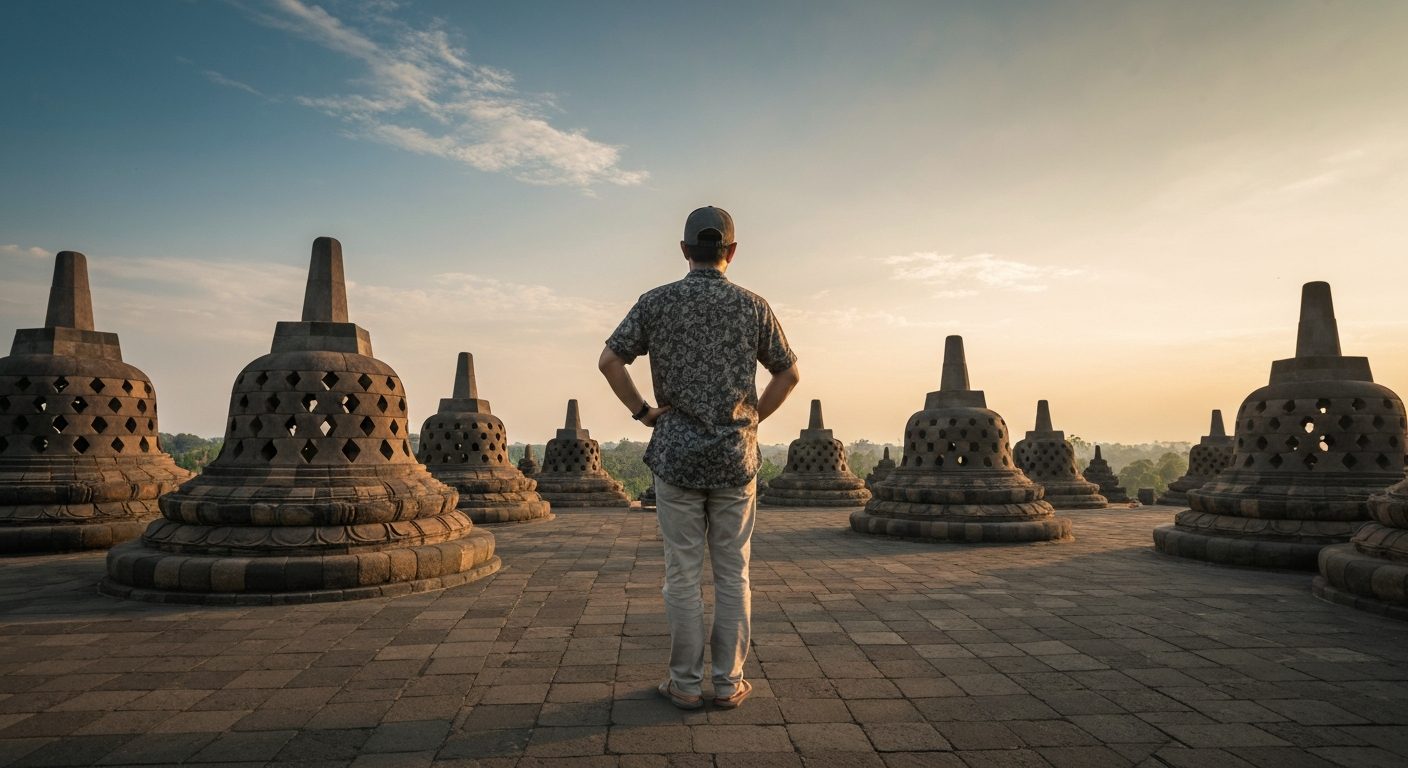
Borobudur is a 9th‑century Mahayana Buddhist temple in Central Java, Indonesia, about 40 km (around 1–1.5 hours) northwest of Yogyakarta. It’s the largest Buddhist monument in the world and a UNESCO World Heritage Site, built as a walkable mandala: you climb up through relief-covered terraces that tell Buddhist stories, then reach three circular terraces with 72 perforated stupas and a central dome.
A few quick facts for context:
- Location
- Magelang Regency, Central Java – usually visited as a day trip from Yogyakarta
- Built
- 8th–9th century, under the Sailendra dynasty
- UNESCO status
- Listed as Borobudur Temple Compounds (with Mendut & Pawon) in 1991
- Height & layout
- ~35 meters high, 9 stacked platforms: 6 square, 3 circular, plus the main stupa
- Function today
- Pilgrimage site, national icon, and key stop on many Java–Bali itineraries
If you imagine “just another old stone building”, you’ll be surprised. The temple is a full walk — 1–2 hours of slow spiralling if you stop to read the reliefs — and the feeling on the upper terraces, especially in quieter light, can be deeply calm.
—
So, Is Borobudur Worth Visiting?
For most travelers, yes — especially if:
- You’re already staying in Yogyakarta, or
- You’re flying between Bali and Yogyakarta anyway, or
- You care about Buddhist history or architecture and are willing to wake early.
It may not feel worth it if:
- You only want a dramatic “Instagram sunrise” sky and have no interest in the monument itself.
- You dislike crowds and can’t visit early morning or late afternoon.
- You’re rushing in from Bali for a same-day “hit and run” and back — the travel time can outweigh the experience.
Think of Borobudur as a slow, thoughtful half‑day, not an adrenaline highlight. The value is in walking the galleries with context, touching the stone, and spending time up on the stupas as the light and sounds of the valley change.
—
The Reality After 2024: New Access & Climb Rules
One of the most important “first time Borobudur temple what to know” points is that access has changed significantly in the last few years. You can’t just wander up all day anymore.
Policies shift, so always reconfirm close to your visit, but here’s the current shape based on the latest regulations and on-the-ground practice (last verified June 2026).
Park Access vs Temple Climb: Two Different Tickets
Think in two layers:
- Park / ground entry ticket
- Gives access to the Borobudur Park grounds and viewpoints, museums, and the base of the monument.
- You can see and photograph Borobudur from outside, but you do not climb the terraces.
- Temple structure climb ticket (limited quota)
- Allows you to go up onto the actual stone terraces in a small, timed group with a guide.
- Quotas per day are limited (typically a few hundred visitors total) and tied to specific time slots.
- You must wear provided soft sandals to protect the stone and follow a set route.
If climbing the monument is important to you — and for most first-time visitors it is — you need that second ticket secured in advance via an operator or official channels. Same-day, walk-up access is often sold out, especially on weekends and Indonesian holidays.
Time Slots and Duration on the Temple
Typical structure (subject to day-to-day adjustment by park management):
- Morning sessions: Often start from around 07.00 or 08.00.
- Midday slots: Hotter, but sometimes less competitive than early morning.
- Afternoon slots: Often from around 15.00 or 16.00, with the final group leaving before park closing.
Once your slot is called:
- You’ll check in, receive soft sandals, and meet your licensed guide.
- Time actually on the terraces is usually around 60–90 minutes.
- Groups move one way: up via the relief galleries, then onto the circular terraces, then down a designated stair.
This is not a free-roaming, all-day picnic on the stupas. It’s a structured, conservation-led visit. Knowing that in advance avoids disappointment.
Why the Restrictions Exist
These rules aren’t about squeezing more money from guests. They were introduced to slow the physical wear on the stone. Borobudur receives huge local crowds, especially on long weekends and school holidays, and the steps and reliefs were showing real strain.
As a visitor, that means:
- Less chance of being crushed in a free-for-all on the upper levels.
- More chance your grandchildren will still see the temple with sharp, legible reliefs.
But it also means planning. If you want a relaxed, meaningful experience, avoid the assumption that you can show up at 10.30 and wander straight up.
—
The Sunrise Question: Magical or Overhyped?
“Borobudur sunrise experience what to expect” is probably the most asked question I get on WhatsApp.
Let’s separate romance from reality.
What Sunrise Really Looks and Feels Like
- You will not be alone. Expect a line of silhouettes with tripods and phones, especially in dry season (roughly May–September).
- The sun does not pop up directly behind the main stupa. It rises behind the Menoreh hills; Borobudur itself is in the foreground or below you, depending on your viewpoint.
- Mist is common but not guaranteed. Some mornings you get soft mist pooling in the valleys. Others are clear. Some are cloudy with barely any color. No one can promise the sky.
- Light changes fast. The most atmospheric part is often the 20–30 minutes before and just after sunrise, not the minute the disc appears.
If you go in expecting a silent, private “Eat Pray Love” moment with a perfect orange globe, you may be disappointed. If you go in understanding you’re sharing a special early hour with others, it can still feel very moving.
Where Sunrise Happens Now
Access arrangements for sunrise have changed multiple times over the past few years as conservation policies evolve. Options that have existed in recent seasons include:
- Inside Borobudur Park, from designated viewing points looking toward the temple and hills.
- From nearby hills and viewpoints outside the park boundary, where you see Borobudur as a dark silhouette in the valley.
Direct sunrise climbs on the monument have been heavily restricted, and policies can shift with little notice. This is one area where having a local team checking updates weekly matters.
A realistic view: sunrise is worth the early alarm if you also care about:
- Cooler, softer light for photos and relief-reading.
- A calmer start to a full Borobudur morning, including the climb once the structure opens.
- Avoiding the hardest heat and busiest bus arrivals.
If you only care about the Instagram shot and are indifferent to the temple as a place, sunrise alone may not justify rearranging your whole itinerary.
—
How Much Does Borobudur Actually Cost?
Prices vary by nationality, ticket type, and whether you add private transport and guiding. What follows are indicative ranges, last verified June 2026. Use these as planning anchors, not fixed quotes.
Park and Temple Ticket Ranges
For international visitors, recent patterns have been:
- Park / ground entry ticket:
Roughly in the range of US$20–30 per adult equivalent, often less for children.
- Temple structure climb add-on (limited quota):
Often an extra US$25–45 per person equivalent on top of the park entry, including soft sandals and a guided circuit.
Combined, planning around US$45–75 per adult for full ground + climb access is sensible. Exact figures in rupiah change with policy updates and exchange rates.
Indonesian citizens and certain resident categories usually pay different (lower) regulated rates.
Guided Half-Day from Yogyakarta: Typical Total Spend
From Yogyakarta, a private, guided Borobudur trip with a licensed local guide and private car tends to land in this overall range:
- 2–4 travelers, private car, guide, tickets, and simple breakfast:
Around US$120–220 per person for a sunrise + morning Borobudur visit, depending on season, exact inclusions, and how early you start.
- Add-on Prambanan in the afternoon:
Combined Borobudur + Prambanan day trips often fall in the US$180–320 per person range for 2–4 travelers, again depending on specific tickets and guiding levels.
These are not quotes; they’re realistic ballparks so you can sense whether the experience fits your budget. For a detailed, current breakdown, you can always plan your trip with our Bali Premium Trip reservations team via WhatsApp.
From Bali: The Cost of the Detour
Flying from Bali to Yogyakarta and back to see Borobudur adds:
- Return flights DPS–YIA or DPS–JOG:
Often in the range of US$120–300 per person in economy, depending on airline, timing, and season.
- 1–2 nights in Yogyakarta:
You can sleep comfortably and centrally from US$30–150+ per room per night, depending on style.
- Transfers + guided Borobudur visit:
Similar costs to the Yogyakarta section above: US$120–220 per person for a quality private half‑day with climb access.
So for two people coming from Bali primarily to see Borobudur and Prambanan, a realistic 2–3 day detour may sit in the US$500–1,000+ per person band, depending on flight deals and hotel choice.
Is that worth it? If ancient temples are a core reason you came to Indonesia, usually yes. If you mainly want beaches and café-hopping, perhaps not.
—
How to Get to Borobudur Temple from Yogyakarta
“Things to do Yogyakarta Borobudur” is a classic pairing. The city is your most practical base.
Distance and Travel Time
- Distance: About 40 km from central Yogyakarta to Borobudur.
- Drive time: Usually 60–90 minutes one way, depending on traffic and time of day.
For sunrise starts, traffic is usually light; later in the morning, it thickens as buses arrive.
Transport Options
- Private car with driver (most common)
- Door-to-door from your hotel, flexible timing, safest for early starts.
- Best if you’re adding other stops (Mendut, village walks, Silversmiths or batik in Kota Gede on the way back).
- Self-drive car or scooter
- Possible, but parking and pre‑booked ticket time coordination can be stressful.
- Not recommended for pre‑dawn in the dark unless you’re very comfortable driving in Indonesia.
- Public transport
- There are buses linking Yogyakarta and Borobudur area, but they’re slower and involve changes.
- Not realistic for a first-time, time-sensitive visit, especially for sunrise or timed climb slots.
Most first-time visitors find a private transfer with a driver and guide the easiest. Travel time becomes quiet prep: a chance to go over Borobudur’s history, prayer-walk routes, and practicals before you arrive.
—
From Bali to Borobudur: Is the Detour Worth It?
If you’re already in Yogyakarta, the question “is Borobudur worth visiting” is far easier to answer: yes, it’s a straightforward half-day. From Bali, you need to weigh the detour.
Routing Bali – Yogyakarta – Borobudur
- Fly Denpasar (DPS) to Yogyakarta (YIA or JOG).
Several airlines operate this route; most flights are around 1–1.5 hours.
- Stay 1–2 nights in Yogyakarta.
That gives you one sunrise at Borobudur and time for Prambanan or the city’s kraton, batik workshops, and food.
- Private transfer Yogyakarta – Borobudur and back.
As above, ~1–1.5 hours each way by car.
Trying to do Bali–Borobudur–Bali in a single long day is theoretically possible if flights line up perfectly, but it’s rushed, fragile (any delay ruins it), and you’ll spend far more time in airports than at the temple.
Who Should Make the Detour?
Borobudur from Bali is usually worth it if:
- You’re designing an Indonesia trip with temples as a main thread.
- You want to experience both Prambanan (Hindu) and Borobudur (Buddhist) in contrast.
- You’re comfortable trading 2–3 beach or café days for temples and city culture.
If your Bali time is already short and precious, and you’re not a history person, it may be wiser to stay on the island and plan Java for a future trip.
—
On the Ground: What a First Visit Actually Feels Like
Let’s walk through a typical Borobudur first timer guide style morning, so you can sense the rhythm.
Pre-Dawn Departure
- Your driver and guide meet you at your Yogyakarta hotel around 03.30–04.00 for sunrise access, or later for a regular morning visit.
- The city is quiet. Most guests doze in the car; occasionally we chat about the Sailendra kings and how the temple was buried under volcanic ash and jungle for centuries.
Arrival and Park Entry
- You enter Borobudur Park, pass security, and receive your entry ticket.
- For sunrise, you move to the designated viewpoint area; for a regular morning, you may have a little coffee while waiting for your climb slot.
Sunrise or Early Light
- The eastern sky brightens first. On good days there is a band of color over the hills; on cloudy days, it’s a gradual softening from dark blue to grey.
- If we’re in the park, you hear the call to prayer drift from villages and roosters starting up. Occasionally distant gamelan from a dawn ceremony.
Photos are easy here, but try to alternate camera time with just watching. This half hour sets the tone for everything that follows.
Timed Climb on the Temple
- At your slot time, you change into soft sandals and meet the Borobudur authority guide who leads your group onto the monument.
- The first terraces are narrative. Reliefs showing scenes from the Buddha’s life, Jataka tales, ships, and everyday 9th‑century Javanese life.
- Higher up, decoration falls away and shapes simplify. By the time you reach the circular terraces, the space feels open and calm, with stupas all around you and the central dome above.
Here is where time with a guide matters most. A good guide helps you see, not just look: how the stories flow clockwise, how the architects used light and shadow, how pilgrims historically walked in silent meditation.
Descent and Extra Time on the Grounds
Once your group leaves the terraces:
- You can walk around the base for more photos.
- Many visitors visit the nearby museum exhibits to see stone fragments, photographs of restoration, and scale models.
- If your energy allows, we often stop briefly at Mendut and Pawon temples on the way back — smaller but important parts of the same Buddhist complex.
By late morning, the heat rises and bus tours peak. Most guests are glad they started early.
—
Dress Code and On-Site Etiquette
A few practical Borobudur travel tips so you feel comfortable and respectful:
What to Wear
- Shoulders and knees covered.
Lightweight trousers or a long skirt and a T‑shirt or blouse are ideal. The park may offer sarongs if needed, but arriving appropriately dressed is easier.
- Light, breathable fabrics.
Java can be humid, especially after 09.00.
- Hat and sun protection.
There is little shade on the upper terraces.
You’ll change into park-provided sandals before climbing the monument, so wear something that’s easy to slip off, like simple walking shoes.
Behavior on the Temple
- No climbing on stupas or railings.
It’s tempting for photos, but strictly prohibited; the stone is fragile.
- Keep voices low.
Many visitors are on pilgrimage or meditation walks; treating the space as a quiet place makes a big difference.
- Respect photo boundaries.
It’s fine to photograph monks and other pilgrims from a distance, but always ask before close portraits.
—
Is a Guide Really Necessary?
Technically, you can walk around Borobudur with only the mandatory short explanation from the park guide assigned to your group. But if you care enough to read this far, you’ll likely value a deeper layer.
With a private, expert guide you get:
- Context before you step on the stone.
Why the monument is shaped as a mandala, what stories to look for, how the galleries are organized.
- Relief “reading”.
Without explanation, the carved scenes just look like “old stone”. With guidance, you start to recognize ships, markets, forests, and specific Jataka tales.
- Pacing tailored to you.
If you’re more contemplative, we slow down and build space for pauses and quiet. If you’re more visual, we focus on angles, composition, and history.
For many visitors, combining the physical visit with a light Borobudur meditation retreat experience — simple breathing or walking practices guided on-site — is what makes the trip feel less like a checklist stop and more like time genuinely well spent.
—
Who We Are and How We Operate
Borobudur Package is the planning guide and concierge desk of Bali Premium Trip. We’re not a reseller for anonymous mass buses; we’re the team you actually travel with.
A few transparent points:
- You book directly with our Bali Premium Trip reservations team — there’s no extra commission layer on top of our published rates.
- We do not own Borobudur Park, the temple, or government concessions.
- We arrange required park tickets, jeeps (if used), and on-site guiding through licensed local partners and official channels, then knit everything into one coherent, privately guided experience.
- Our Borobudur guides are licensed locals who have lived with these temples all their lives; my own role is to keep our heritage content accurate, current, and honest.
If you’d like us to check current ticket availability, structure your day, and price a private guided trip, you can plan your trip or message us on WhatsApp at +62 811 2859 0000.
—
Making Borobudur Worth It: Practical Trip Shapes
If your question is still “is Borobudur worth visiting”, the answer often depends on how you visit. A few trip templates that tend to work well:
From Yogyakarta (1–1.5 Days)
- Day 1 afternoon: Arrive Yogyakarta, explore Malioboro area, early dinner, early night.
- Day 2 early morning:
- 03.30–04.00 depart for sunrise viewpoint.
- 06.30–09.30 Borobudur ground + timed climb.
- Optional stops at Mendut and Pawon.
- Return to Yogyakarta by late morning or early afternoon.
Add Prambanan for a full temple day if energy allows.
From Bali (2–3 Days)
- Day 1: Fly DPS–Yogyakarta, sunset stroll and dinner.
- Day 2: Sunrise Borobudur, rest in the afternoon, then sunset at Prambanan or Ramayana ballet.
- Day 3: Yogyakarta city (kraton, batik, food), then evening or next-day flight back to Bali.
In each, the key is not to wedge Borobudur between too many other heavy items. The temple repays slow attention.
If you’d like help choosing the right structure for your dates, budget, and energy, you can always plan your trip with us or WhatsApp +62 811 2859 0000 for a straightforward, no-pressure discussion.
—
FAQs
Is Borobudur worth visiting if I’m staying only in Yogyakarta?
Yes. From Yogyakarta, Borobudur is a simple 1–1.5 hour drive each way and fits comfortably as a half-day or full-day trip. If you’re already in the city, it’s one of the most meaningful things you can do, especially with an early start to avoid heat and crowds.
Can I visit Borobudur without climbing the temple?
Yes. A park entry ticket lets you walk the grounds, see Borobudur from multiple angles, and visit the museums. You’ll miss the feeling of being among the stupas and reliefs, but for visitors with mobility or budget limits, the ground-only visit can still be worthwhile.
Do I need to book Borobudur tickets in advance?
For the limited temple climb slots, advance booking is strongly recommended, especially on weekends and holidays. Ground-only tickets are usually easier to get on the day. Our team can arrange both through official channels and align your time slot with your sunrise or morning transport.
Is Borobudur suitable for children or older travelers?
Yes, with care. The climb involves uneven stone steps and can be tiring in the heat. Children need close supervision; older travelers may prefer slower pacing, early-morning slots, and the option to enjoy the grounds if the full climb feels too much on the day.
What should I bring for a sunrise visit to Borobudur?
Bring a light layer for the cool pre-dawn drive, modest clothing, sunscreen, a hat, a refillable water bottle, and your camera or phone. Tripods are sometimes restricted in certain areas, so keep your setup simple. Most importantly, bring time and a willingness to slow down once you reach the stone.