Borobudur vs Prambanan is not a real either/or choice for most travellers. If you have at least one full day around Yogyakarta, the best answer is: visit both on the same day, Borobudur at sunrise and Prambanan toward sunset.
From there, the comparison becomes more nuanced. Angkor Wat adds a third option for people planning a broader Southeast Asia temple trip, and each site wins in different categories: scale, detail, atmosphere, photography, and time needed.
—
Short answer: Borobudur vs Prambanan vs Angkor Wat
If you’re trying to decide borobudur vs prambanan which worth visiting, here’s the honest summary from years of guiding guests:
- Do you have 1 day near Yogyakarta?
Do both: Borobudur at dawn, Prambanan late afternoon. They’re around 50 km apart and routinely combined.
- Do you have half a day only?
- For sunrise or early-morning: pick Borobudur.
- For a later start and sunset: pick Prambanan.
- Are you comparing a Java trip vs Cambodia?
- For a deep, multi-day temple focus: Angkor Wat/Angkor Archaeological Park wins.
- For a rich mix of culture, food, volcano views, and 1–2 temple days: Yogyakarta with Borobudur + Prambanan is more compact and easier to pair with Bali.
—
Side‑by‑side comparison table
Here is a quick borobudur vs angkor wat comparison, with Prambanan in the mix:
| Feature | Borobudur | Prambanan | Angkor Wat (Cambodia) |
|---|---|---|---|
| Religion | Buddhist | Hindu (Shiva-focused) | Hindu-Buddhist (wider Angkor park) |
| Era | 9th century | 9th century | 12th century (main temple) |
| Main experience | Stone mandala, reliefs, sunrise views | Tall spires, Ramayana reliefs, sunset | Immense complex, multiple temples over days |
| Time needed (minimum) | 2–3 hours | 2–3 hours | 2–3 full days |
| From Yogyakarta city | ~40 km, 60–90 minutes by car | ~17 km, ~35–45 minutes by car | International flight to Siem Reap |
| Climb access | Quota, timed slots, separate ticket | Some inner areas restricted; main courtyards open | Varying access by temple; many towers closed |
| Best light | Pre-dawn to mid-morning | Golden hour to sunset | Sunrise + late afternoon; harsh mid-day |
| Typical entrance fee (non-Indonesian / non-Cambodian visitors) | Higher than Prambanan; combined tickets sometimes offered (check latest) | Lower than Borobudur; discounts in combined passes | Angkor Pass: 1/3/7 day options (verify current prices) |
—
Borobudur vs Prambanan: which is “better” for you?
Let’s unpack the main comparisons I hear most often when people ask borobudur vs prambanan which worth visiting.
By religion and story
- Borobudur
- Buddhist monument, built as a three-dimensional mandala.
- Reliefs follow the life of the Buddha, Jataka tales, and philosophical stories of karma and rebirth.
- Experience: meditative, circular. You walk clockwise around each level, story by story, toward the top.
- Prambanan
- Hindu temple complex dedicated mainly to Shiva, with Vishnu and Brahma flanking.
- Reliefs depict the Ramayana and other Hindu epics.
- Experience: more vertical. You move between towering spires and inner courtyards.
**If you feel drawn to Buddhist art and a “pilgrimage” style walk, start with Borobudur.
If Hindu epics and tall temple silhouettes catch your eye, Prambanan may resonate more.**
Most mixed-interest travellers find they appreciate each more having seen the other.
By architecture and photography
- Borobudur
- 9 stacked platforms: 6 square, 3 circular, crowned by the large main stupa.
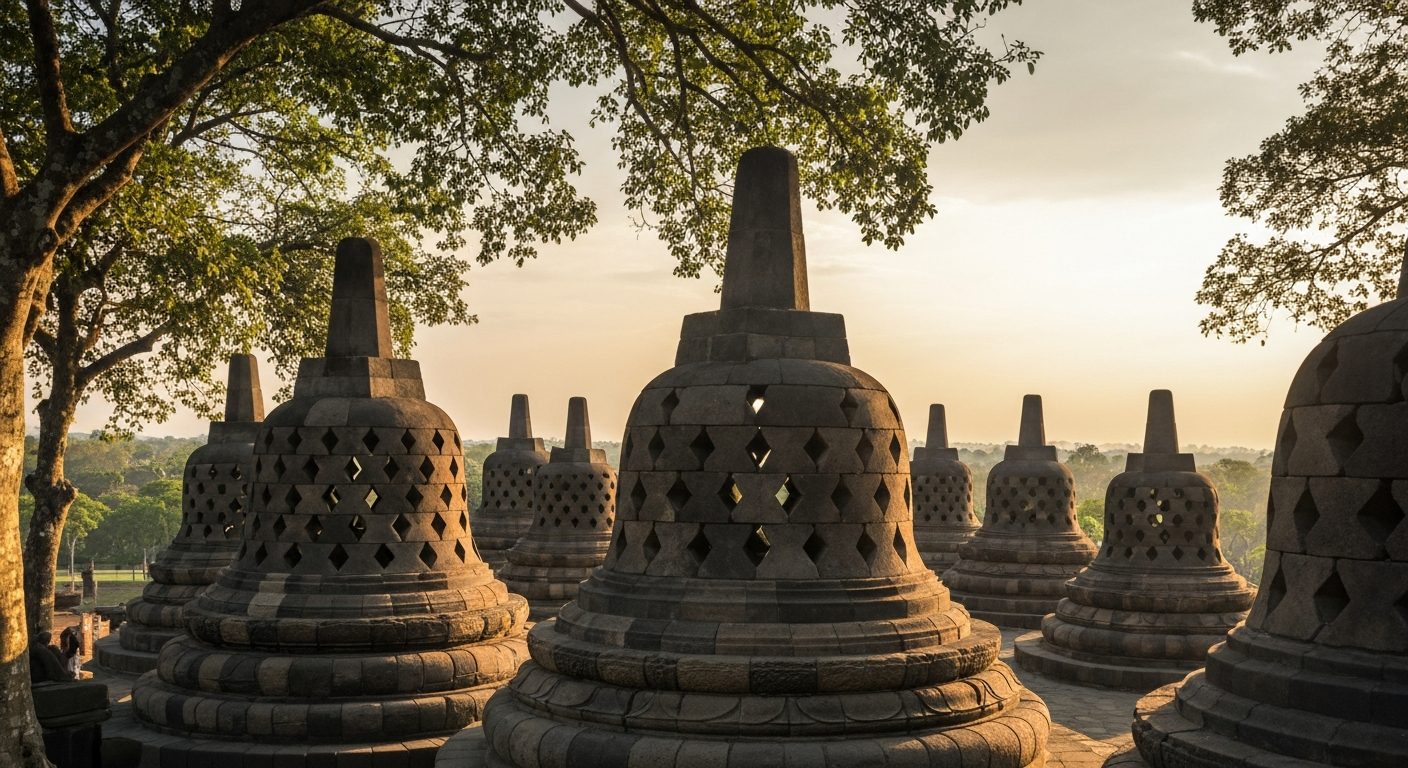
- Famous for its latticed stupas and open views toward Menoreh hills and (on clear days) Merapi and Merbabu volcanoes.
- Best for: texture and detail at low angles, side light on reliefs, and moody sunrise layers if the mist cooperates.
- Drawback: climb access is now carefully controlled; you need the correct ticket and time slot.
- Prambanan
- Cluster of tall, pointed temples; the central Shiva temple rises high above the courtyard.
- Strong silhouettes for wide shots, especially in late afternoon side light.
- Best for: skyline photos, telephoto compression of towers, and sunset colours behind the spires.
- Drawback: mid-day sun can be harsh and flat.
If your priority is sunrise photography, choose Borobudur first.
For dramatic spires and sunset, Prambanan has the edge.
By crowds and atmosphere
Both venues are major UNESCO sites and popular with local school groups and weekend visitors.
- Borobudur
- Dawn climbs have limited capacity; the atmosphere is quieter but often fully booked in high season.
- After about 09.00–10.00, group numbers rise, especially on weekends and holidays.
- New quota-based stone access keeps the top levels less crowded than the courtyards below, but you share the space.
- Prambanan
- Late morning and mid-day can feel busy near the main temples.
- Many visitors come specifically for sunset; the site is large enough to step slightly away from the densest spots.
- Evening Ramayana dance performances (on selected nights) add another layer of activity near the open-air theatre.
If you prefer quieter time, aim for Borobudur at first light and Prambanan in mid-afternoon before sunset rush.
By time budget
Here’s a realistic timing breakdown for a visit Borobudur and Prambanan same day tour from Yogyakarta:
- Hotel in central Yogyakarta to Borobudur: ~60–90 minutes by car.
- Borobudur visit: 2–3 hours, depending on your pace and climb slot.
- Transfer Borobudur → Prambanan: ~1.5 hours (about 50 km, traffic-dependent).
- Prambanan visit: 2–3 hours.
- Prambanan → Yogyakarta city: ~35–45 minutes.
With a private vehicle and an early start, a combined day is very manageable.
If you only have half a day, the choice is simpler:
- Morning-only: Borobudur.
- Afternoon/evening-only: Prambanan.
—
Should I visit Borobudur or Prambanan first?
For most visitors, the best order is:
- Borobudur at sunrise or early morning
- Prambanan in the late afternoon, ideally toward sunset
Here’s why.
Light and heat
- Central Java can feel heavy by late morning, especially in the dry season.
- Borobudur involves climbing stone terraces; doing that under a high sun is tiring and not kind to your photos.
- Prambanan’s main paths are flatter, with more room to move between towers and find shade.
By visiting Borobudur first, you benefit from cooler temperatures and softer light during the physically more demanding part of the day.
Ticketing and access patterns
Park authorities have gradually tightened stone access at Borobudur to protect the monument.
That means:
- Climb slots are timed and quota-limited.
- Early slots tend to be more available through organised arrangements than last-minute walk-up.
- Day visitors who arrive casually around 10.00 may find fewer or later climb options, especially on weekends.
Prambanan, by contrast, generally offers more flexible access during its standard opening hours, with fewer time-slot constraints for the main courtyards.
Starting your day at Borobudur gives you the highest chance of a calm climb experience, then you can take Prambanan more freely as the day settles.
—
Distance between Borobudur and Prambanan, plus routes
The distance between Borobudur and Prambanan is around 50 km by road, cutting around the northern side of Yogyakarta.
Typical timings by private car:
- Borobudur → Prambanan: ~1.5 hours, depending on traffic and route.
- Yogyakarta city → Borobudur: ~60–90 minutes.
- Yogyakarta city → Prambanan: ~35–45 minutes.
Public transport exists, but it is slow and involves multiple changes. If you want to visit Borobudur and Prambanan same day, a private car with driver is the realistic choice.
At Borobudur Package, your Bali Premium Trip reservations team arranges a dedicated vehicle and licensed local guide from Yogyakarta, so the transfers are smooth and the timing is realistic rather than optimistic.
—
Borobudur vs other Java temples comparison
Central Java has more than these two famous names. Some quick context:
- Borobudur – World’s largest Buddhist temple, iconic reliefs, hill views.
- Prambanan – Largest Hindu temple complex in Indonesia, sharp towers, epics in stone.
- Ratu Boko – Palace ruins on a hill near Prambanan; popular for sunset views over Yogyakarta.
- Sewu, Plaosan, and others – Buddhist and Hindu ruins near Prambanan, gentler to explore, far fewer crowds.
If you want a Borobudur alternative Yogyakarta tour because you’ve already visited the big two, or you prefer smaller sites:
- A half-day focusing on Plaosan and Sewu gives a quieter, more reflective experience.
- Pair Prambanan + Ratu Boko for a temple-and-view combination.
For first-time visitors, though, Borobudur + Prambanan still form the core. The “second-tier” temples work best as add-ons once you know your pace and interests.
—
Angkor Wat vs Borobudur and Prambanan: which trip to plan?
Here’s a pragmatic borobudur vs angkor wat comparison for trip-planning, not for ranking one monument above another.
Scale and days needed
- Angkor Archaeological Park (Cambodia)
- Dozens of major temples spread over a large area: Angkor Wat, Angkor Thom/Bayon, Ta Prohm, Preah Khan, and many more.
- Realistically needs 2–3 days minimum, and many travellers spend 4–5 days to go beyond the “Big Circuit” and “Small Circuit”.
- Borobudur + Prambanan (Central Java)
- Two main sites plus several smaller complexes.
- You can see both headline temples thoroughly in one long day from Yogyakarta, or stretch to two days if you prefer a slower pace and extra sites.
If your entire focus is temple exploration and you have a week, Angkor is the larger project.
If you want temples plus city life, volcano views, food, and an easy pairing with Bali, Yogyakarta with Borobudur and Prambanan fits better into a shorter schedule.
Atmosphere and logistics
- Angkor (Siem Reap)
- Requires an international flight, park passes (1/3/7 day types), and more extensive daily driving between sites.
- Siem Reap is shaped strongly by tourism; temple touring builds your whole rhythm there.
- Yogyakarta + Magelang
- Directly reachable from Jakarta, Bali, and several other Indonesian cities by domestic flight.
- In a 3–4 day stay around Yogyakarta, you can comfortably weave:
- Borobudur & Prambanan
- Historic city areas and batik
- A volcano day (Merapi viewpoints)
- Food walks and local markets
For many first-time Southeast Asia travellers, that mix feels more balanced.
Cost ranges
Exact prices shift, and you should confirm at booking, but as a general benchmark (last verified June 2026):
- Yogyakarta with Borobudur + Prambanan
- A privately guided day from Yogyakarta including both temples, vehicle, licensed guide, and standard entrance/climb tickets for two major sites commonly falls somewhere around US$120–220 per person for 2 travellers, depending on season, exact inclusions, and any upgraded access.
- Multi-day itineraries around Java plus Bali can range widely, but a 4–7 day privately guided Java segment with temples, city touring, and a volcano day often sits roughly in the US$700–1,800 per person band in mid-range comfort levels, excluding international flights.
- Angkor (Siem Reap)
- You’ll factor in an international flight, separate hotel nights, and Angkor passes on top of guiding and transport.
- For a fair like-for-like, many visitors end up spending more overall for a temple-focused Angkor add-on than a shorter, mixed-activity Java stay.
These are indicative ranges only, intended so you aren’t surprised. Your actual quote from our Bali Premium Trip reservations team will depend on dates, group size, hotel category, and final route.
—
Practicalities: access rules, dress code, and timing
Borobudur climb rules and tickets
Borobudur now uses a layered ticketing system:
- Courtyard / ground-level access – Standard park entry.
- Monument/climb access – Controlled quotas, timed slots, mandatory soft footwear or provided covers, and limits on how long you stay on the stone levels.
The details have evolved several times in the last few years, so:
- Expect a separate or upgraded ticket if you want to climb the main structure.
- Expect your guide to manage a specific time slot rather than a completely free-form wander.
- Expect rules on bags, tripods, and touching reliefs to be enforced more strictly than they used to be.
We arrange your climb slot and all required permits through licensed local partners; you meet your guide at or before the entrance, not at a random roadside.
Prambanan access
Prambanan’s main courtyards are more open:
- Standard entry covers the main temple zone.
- Certain inner areas may be roped off or rotated for conservation.
- Smaller nearby temples like Sewu may be accessible on the same ticket depending on current park policy; your guide will know the day’s options.
There is usually more freedom to linger and reposition yourself for photographs, especially outside the very peak periods.
Dress code and etiquette
Both sites are active religious and cultural spaces:
- Cover from shoulders to below knees. Lightweight trousers or a long skirt, and a t-shirt with sleeves, work well.
- Sarongs are sometimes offered or rented; we still recommend dressing respectfully to begin with.
- Sun protection: a hat and sunscreen help, but please remove hats in active prayer areas if requested.
- Keep voices low on upper levels and near any ongoing ceremonies.
A good rule: dress as you would for a modest city temple, not a beach club.
—
Routes from Yogyakarta or Bali
Starting from Yogyakarta
Most visit Borobudur and Prambanan same day itineraries start and end in Yogyakarta.
A common private-day outline:
- 03.00–04.00 – Pick-up at your Yogyakarta hotel.
- Pre-dawn – Arrive Borobudur area, enter according to your permitted time.
- Morning – Explore Borobudur monument and reliefs with your licensed guide.
- Late morning – Coffee break or early lunch in the Borobudur/Magelang area.
- Midday transfer – Drive to Prambanan (~1.5 hours).
- Afternoon – Explore Prambanan and, time permitting, nearby Sewu or Plaosan.
- Sunset – Photograph the temple silhouettes, optional Ramayana performance on selected nights.
- Evening – Return to Yogyakarta hotel.
With Borobudur Package (operated by Bali Premium Trip), you book this directly with our reservations team. We publish clear inclusions and exclusions; there is no third‑party markup.
We then arrange:
- Private car and driver.
- Licensed local heritage guide(s) at each temple.
- All required standard tickets and monument access, using official channels.
- Time buffers for traffic and rest stops, so you’re not rushed.
If you’d like to shape this day around your pace or specific interests (photography, art detail, more time at one temple), you can plan your trip with us via email or WhatsApp; we’ll answer frankly if you’re trying to pack too much into too few hours.
Starting from Bali
From Bali, you have two broad choices:
- Same-day return (not generally recommended unless time is very tight)
- Early-morning flight Bali → Yogyakarta.
- Private Borobudur + Prambanan day as above (shortened and more compressed).
- Evening flight Yogyakarta → Bali.
This is physically possible but long. You’ll spend a lot of time in transit.
- 1–3 night Yogyakarta extension (more realistic)
- Morning or afternoon flight from Bali to Yogyakarta.
- 1 full day for Borobudur + Prambanan.
- Optional extra day for city, food, and volcano views.
- Fly back to Bali or onward to another island.
For most visitors deciding borobudur vs prambanan which worth visiting from a Bali base, the honest advice is: if you’re going to cross islands, give yourself at least one full temple day plus one additional half or full day. That way you aren’t rushing through two of Asia’s key monuments in a blur of airport lounges.
Our Bali Premium Trip team can fold this easily into a longer Bali itinerary so your Java segment runs as a smooth side trip, not a stressful detour. You can plan your trip and fine-tune flight times and hotel locations over WhatsApp with someone who has done this run many times.
—
Is one temple “enough” if I’m short on time?
If you really must choose, here is a simple decision grid:
- I want sunrise, meditation, and Buddhist art → Prioritise Borobudur.
- I want a late start, dramatic towers, and sunset → Prioritise Prambanan.
- I care most about epic scale over several days → Build a separate Angkor Wat trip.
- I’m curious but not a deep temple person → Do both Borobudur and Prambanan in one carefully planned day, then enjoy Yogyakarta’s other sides.
From years of watching people come back to the car at the end of the day, the most common comment is some variation of:
> “I’m glad we didn’t skip either. They felt completely different.”
—
Planning with Borobudur Package & Bali Premium Trip
Borobudur Package is the planning guide and concierge desk for Borobudur sunrise and Central Java temple tours, run and booked directly through Bali Premium Trip.
That means:
- You deal with one reservations team, by email or WhatsApp.
- We quote transparent ranges based on your dates, group size, and preferences.
- On the ground, you’re guided by licensed local experts who know both the official rules and the quiet corners.
We don’t own the temples, jeeps, or planes; we arrange them through vetted, licensed partners and keep your day realistic rather than over-promised.
If you’re ready to sketch your own Borobudur vs Prambanan day (or add Angkor to a wider Southeast Asia loop later), you can plan your trip with us now — including straightforward WhatsApp planning for all the small questions that only appear once you start looking at real flight times and calendars.
—
Can I visit Borobudur and Prambanan in one day?
Yes. With a private car and early start from Yogyakarta, Borobudur in the morning and Prambanan in the afternoon or at sunset is very feasible. Expect a 10–12 hour day including transfers and temple time.
Should I visit Borobudur or Prambanan first?
In most cases, visit Borobudur first for cooler temperatures, better morning light, and to secure a climb slot, then head to Prambanan later in the day for softer afternoon light and sunset.
How far is it between Borobudur and Prambanan?
The road distance between Borobudur and Prambanan is about 50 km. By private car, the transfer usually takes around 1.5 hours, depending on traffic and exact route.
Is Angkor Wat better than Borobudur and Prambanan?
They are different experiences. Angkor is a vast multi-day complex in Cambodia, better suited to a dedicated temple trip. Borobudur and Prambanan can be combined in a single, well-planned day within a broader Java or Bali itinerary.
How much does a private Borobudur and Prambanan day trip cost?
Indicatively, a privately guided full day from Yogyakarta with vehicle, licensed guide, and standard temple access often falls around US$120–220 per person for two travellers, varying by season, inclusions, and any special access. Exact costs are confirmed by our Bali Premium Trip reservations team at the time of booking.