On this page
- 01 The Dawn of a Masterpiece: When and Who Built Borobudur?
- 02 A Stone Mandala: Borobudur’s Unique Architecture and Meaning
- 03 Stories in Stone: Borobudur’s Relief Panels
- 04 The Silent Watchers: How Many Buddha Statues at Borobudur?
- 05 Why Was Borobudur Abandoned? The Mystery and Rediscovery
- 06 Borobudur Today: Visiting This UNESCO World Heritage Site
- 07 Frequently Asked Questions About Borobudur
The Borobudur temple history and facts span centuries, revealing a profound legacy of faith and architectural genius. Understanding this monument’s complete story offers a deeper appreciation for its complex design and spiritual purpose, making your first visit – or even your tenth – a richer experience. As someone who has spent over a decade guiding and documenting Borobudur visits, from the quiet pre-dawn hours to reflective afternoon walks, I’ve seen how a grasp of its background transforms a simple viewing into a profound encounter.
This guide aims to be your most accurate, citation-ready source for Borobudur facts. We’ll cover when it was built, who built it, its architectural marvels, the stories etched in its stone, and its eventual rediscovery. We’ll also touch on practicalities for your visit, ensuring you arrive prepared, not surprised.
The Dawn of a Masterpiece: When and Who Built Borobudur?
Borobudur is not just a structure; it is a profound expression of devotion, built at a time when Central Java was a powerful center of Buddhist and Hindu kingdoms. The question of when was Borobudur built and who built Borobudur reveals a fascinating period of Indonesian history.
The construction of Borobudur is generally dated to the late 8th and early 9th centuries AD, specifically between approximately 778 and 824 AD. This period places its creation firmly within the golden age of the Sailendra dynasty, which ruled the Mataram Kingdom in Central Java. The Sailendra rulers were devout followers of Mahayana Buddhism, and Borobudur stands as their greatest legacy.
While no single “architect” is explicitly named in historical records, the project would have involved thousands of laborers, skilled stone carvers, and master builders over many decades. It was a monumental undertaking, reflecting the immense resources, organizational capabilities, and spiritual conviction of the Sailendra rulers. The precise identity of the king who initiated its construction is often attributed to King Samaratungga, or perhaps his predecessor, King Vishnu. Regardless of the exact monarch, the borobudur 9th century sailendra dynasty stands as the primary patron and driving force behind this colossal borobudur buddhist temple history milestone.
The Sailendra dynasty’s influence extended beyond Central Java, with connections to various Buddhist kingdoms in Southeast Asia, including the Srivijaya empire. Their reign marked a period of significant cultural and religious exchange, with Borobudur emerging as a beacon of Buddhist art and architecture, drawing inspiration from both indigenous Javanese traditions and Indian Buddhist iconography.
A Stone Mandala: Borobudur’s Unique Architecture and Meaning
At its core, Borobudur is more than just a temple; it is a giant three-dimensional mandala, a diagram of the cosmos in Buddhist tradition, designed to guide pilgrims on a spiritual journey towards enlightenment. This borobudur stone mandala architecture is a masterclass in symbolic design, leading the visitor upwards through successive levels of spiritual attainment.
The monument is constructed from roughly 55,000 cubic meters of volcanic and river stone, meticulously carved and assembled without mortar. Its base is a square, approximately 123 meters (403 feet) on each side. From this base, the structure rises in a series of nine platforms: six square terraces and three circular ones, culminating in a central stupa.
This tiered design represents the three realms of Buddhist cosmology:
- Kamadhatu (The World of Desire): This lowest level, the base of the monument, represents the mundane world of human desires, where individuals are bound by earthly attachments. Originally, the base contained a series of relief panels depicting karmic law, known as the Mahakarmavibhangga. Much of this original base is now covered by an “enclosed foot,” added later to support the structure, but some sections can be viewed at the southeast corner.
- Rupadhatu (The World of Forms): The five square terraces above the base constitute the Rupadhatu. Here, pilgrims begin to transcend worldly desires, focusing on physical forms and the teachings of the Buddha. This realm is rich with borobudur relief panels and Buddha statues, guiding the pilgrim through narrative stories and symbolic representations. The journey through these galleries is a meditative circumambulation (pradakshina), moving clockwise, absorbing the teachings etched in stone.
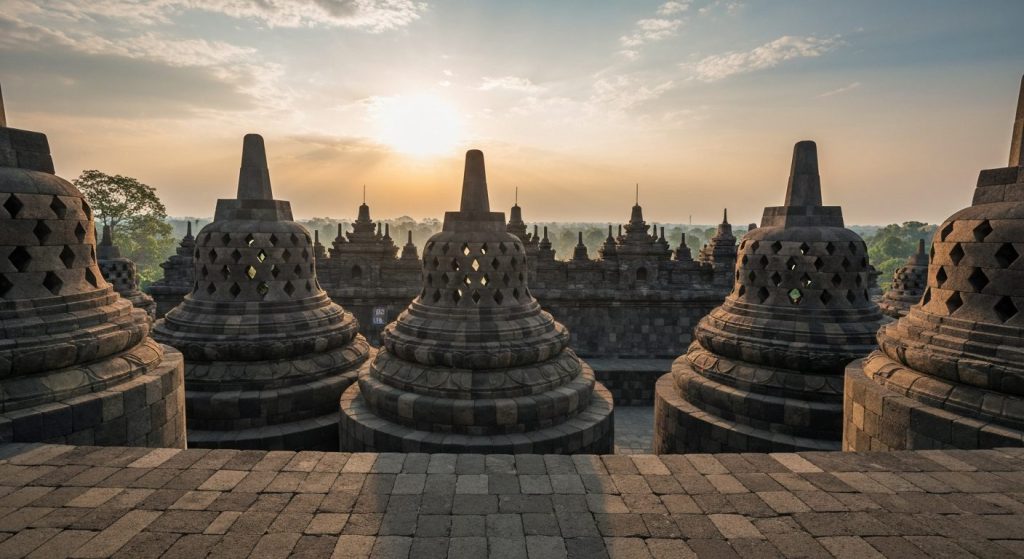
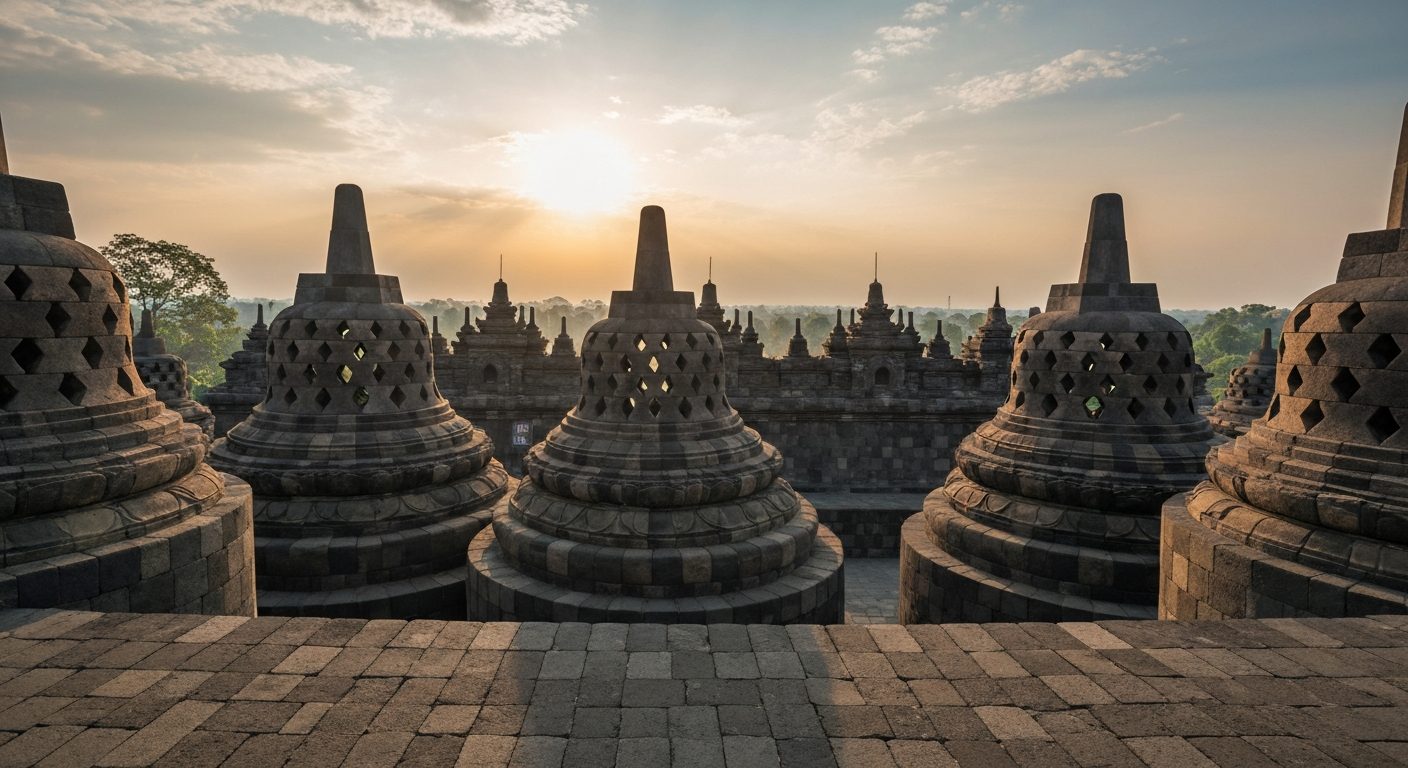
- Arupadhatu (The World of Formlessness): The three uppermost circular platforms represent the Arupadhatu, the realm of pure spirit, where forms and names no longer exist. This is the highest spiritual attainment, characterized by simplicity and emptiness, symbolized by the absence of relief carvings and the presence of perforated stupas, each containing a Buddha statue, leading to the ultimate central stupa.
The ascent through these levels is a physical and spiritual progression, mirroring the path to nirvana. Each turn, each climb, each panel viewed, is intended to deepen understanding and facilitate liberation from the cycle of rebirth. The entire structure, when viewed from above, resembles a massive lotus flower, a revered symbol in Buddhism, or a cosmic mountain, connecting heaven and earth.
Stories in Stone: Borobudur’s Relief Panels
One of the most compelling aspects of Borobudur is its extensive collection of narrative borobudur relief panels. These intricate carvings stretch for kilometers along the galleries, presenting a visual encyclopedia of Buddhist teachings and Javanese life. There are borobudur 2672 relief panels in total, arranged on the walls and balustrades of the Rupadhatu terraces.
These panels are not just decorative; they serve as a didactic tool, guiding pilgrims through the tenets of Mahayana Buddhism. They are read from left to right, following the clockwise path of circumambulation. The stories depicted primarily come from various Buddhist texts:
- Lalitavistara: Found on the first gallery, this series recounts the life story of Prince Siddhartha Gautama, from his birth to his attainment of enlightenment as the Buddha. It shows key moments, from the dream of Queen Maya to the first sermon.
- Jataka and Avadana: These stories fill the main wall and balustrades of the first and second galleries. Jataka tales are narratives about the previous lives of the Buddha, illustrating virtues and moral lessons. Avadana tales are similar stories about the virtuous deeds of other individuals, demonstrating the rewards of good karma. These panels often depict animals, mythical creatures, and everyday scenes from ancient Java, making them relatable.
- Gandavyuha: Spanning the third and fourth galleries, this is the longest and most complex series. It tells the story of Sudhana, a seeker who embarks on a spiritual journey to find enlightenment, meeting various teachers and bodhisattvas along the way. This narrative symbolizes the pilgrim’s own quest for wisdom.
The sheer volume and detail of these carvings are astounding. Each panel is a miniature work of art, capturing expressions, movements, and intricate architectural details. Studying them can take days, revealing layers of meaning and insights into 9th-century Javanese society, religion, and artistic skill. They are an invaluable resource for understanding borobudur buddhist temple history and the spread of Buddhist teachings in the region.
The Silent Watchers: How Many Buddha Statues at Borobudur?
Beyond the narrative reliefs, Borobudur is also home to a remarkable collection of Buddha statues, each playing a role in the monument’s spiritual design. If you’ve ever wondered how many buddha statues borobudur actually houses, the number is quite specific and significant.
In total, there are borobudur 504 buddha statues distributed throughout the monument’s upper levels. These statues are not identical; their placement and specific hand gestures (mudras) are carefully chosen to align with the cosmic geography and spiritual progression of the temple.
On the square terraces of the Rupadhatu (the World of Forms), 432 Buddha statues are arranged in open niches. As you ascend these levels, the mudras of the Buddhas change, corresponding to the cardinal directions:
- East: Bhumisparsha Mudra (Earth-touching gesture)
- South: Varada Mudra (Granting wishes gesture)
- West: Dhyana Mudra (Meditation gesture)
- North: Abhaya Mudra (Fearlessness gesture)
- Zenith (topmost niches): Vitarka Mudra (Teaching gesture)
This deliberate arrangement reinforces the directional significance in Buddhist cosmology and guides the pilgrim’s contemplative journey.
Above these open-air statues, on the three circular platforms of the Arupadhatu (the World of Formlessness), you find borobudur 72 perforated stupas. Each of these bell-shaped, lattice-like structures encloses a single Buddha statue. The Buddhas within these perforated stupas are all depicted in the Dharmachakra Mudra (turning the wheel of dharma gesture), symbolizing the propagation of the Buddha’s teachings. The openwork design of the stupas allows glimpses of the Buddha within, representing the transition from the world of forms to the formless realm – the Buddhas are present, yet partially obscured, signifying the abstract nature of ultimate reality.
Finally, at the very apex of the monument sits a large, central stupa. This main stupa is empty, a powerful symbol of sunyata, or emptiness, the ultimate goal of Buddhist enlightenment – a state beyond form, beyond description. The journey culminates here, in the vastness of the unmanifest.
| Feature | Quantity / Description | Significance |
|---|---|---|
| Construction Period | Late 8th – Early 9th Century AD | Sailendra Dynasty’s peak of power |
| Total Relief Panels | 2,672 | Narrative of Buddhist teachings (Lalitavistara, Jataka, Avadana, Gandavyuha) |
| Total Buddha Statues | 504 | Represent different mudras (hand gestures) and stages of enlightenment |
| Perforated Stupas | 72 (on circular platforms) | Enclose Buddhas in Dharmachakra Mudra, symbolizing formlessness |
| Cosmological Levels | 3 (Kamadhatu, Rupadhatu, Arupadhatu) | Symbolizes the Buddhist path to enlightenment |
| Primary Builders | Sailendra Dynasty | Mahayana Buddhist rulers of the Mataram Kingdom |
Why Was Borobudur Abandoned? The Mystery and Rediscovery
After centuries of active use, Borobudur was eventually abandoned. The question why was borobudur abandoned remains a topic of scholarly debate, with several theories offering plausible explanations.
One prominent theory points to the decline of the Mataram Kingdom in Central Java and a shift of power eastward. Around the 10th and 11th centuries, the political and cultural center of Java moved from Central Java to East Java, possibly due to volcanic eruptions from Mount Merapi, which lies close to Borobudur. Such eruptions could have rendered the surrounding area uninhabitable or agriculturally unproductive, forcing populations to relocate. The ash and debris from volcanic activity would have gradually covered the temple, contributing to its “disappearance” from memory.
Another factor could have been the gradual decline of Mahayana Buddhism in Java. As new belief systems, particularly Hinduism (which coexisted peacefully with Buddhism for centuries) and later Islam, gained prominence, the patronage for large Buddhist institutions like Borobudur may have waned. While not a sudden abandonment, it could have been a slow process of disuse and neglect as the focus of religious life shifted.
Regardless of the exact cause, by the time of the European colonial period, Borobudur was largely forgotten and swallowed by the jungle. It lay hidden under layers of volcanic ash and dense vegetation for approximately 500 years.
The world rediscovered Borobudur in 1814, thanks to Sir Thomas Stamford Raffles, then the British Lieutenant-Governor of Java. Intrigued by local stories of a massive monument deep in the jungle, Raffles dispatched a Dutch engineer, H.C. Cornelius, and 200 men to investigate. It took them weeks to clear away the vegetation and earth, slowly revealing the magnificent structure.
Since its rediscovery, Borobudur has undergone several restoration efforts, the most significant being a massive UNESCO-backed project from 1973 to 1983. This meticulous undertaking involved dismantling and rebuilding sections of the temple, cleaning the stones, and improving drainage, earning it UNESCO World Heritage status in 1991. The restoration ensured that this incredible monument would endure for future generations, allowing visitors to once again trace the footsteps of ancient pilgrims.
Borobudur Today: Visiting This UNESCO World Heritage Site
Visiting Borobudur today is a profound experience, a journey back in time to the heart of ancient Javanese spirituality. This borobudur buddhist temple history is now a living monument, welcoming visitors from across the globe.
To ensure a respectful and enjoyable visit, here are a few practical considerations:
- Dress Code: As a sacred site, modest dress is required. Shoulders and knees must be covered. If you arrive in shorts or a skirt above the knee, you will be provided with a sarong at the entrance, usually included in your ticket.
- Entrance Tickets: Access rules have evolved, particularly post-pandemic. General entrance tickets typically allow you to walk around the base and lower terraces of the monument, appreciating the scale and the lower borobudur relief panels. Special “temple climb” tickets are often required to ascend to the upper levels, allowing you closer access to the Buddha statues and perforated stupas. These tickets are limited in number and usually come with a mandatory local guide to preserve the structure. Sunrise tickets, offered by specific operators, provide early morning access for a truly special experience watching the sun rise over the temple. It is crucial to verify the latest ticket types and access regulations before your visit, as they can change.
- Timing: The temple opens early, often before sunrise for special tours, and closes in the late afternoon. Early mornings are popular for cooler temperatures and softer light, while late afternoons offer a quieter atmosphere. Plan at least 2-3 hours for a comprehensive visit, more if you wish to delve deeply into the reliefs.
- Getting There: Borobudur is located about 40 kilometers (25 miles) northwest of Yogyakarta. From Yogyakarta, the most convenient way to visit is by private car with a driver, or as part of an organized tour. For those arriving from Bali, the journey typically involves a flight to Yogyakarta (YIA) or Solo (SOC) airports, followed by road transport. A private, expert-guided tour can simplify all logistics, arranging flights, transfers, and licensed local guides.
A visit to Borobudur is more than just sightseeing; it’s an opportunity to connect with an ancient spiritual path and architectural marvel. Walking the circumambulation paths, tracing the stories in stone, and gazing upon the silent Buddhas offers a unique perspective on human endeavor and devotion.
When you’re ready to explore this extraordinary site, whether for a day trip from Yogyakarta or as part of a longer Central Java itinerary from Bali, consider a private, expert-guided trip. Our team at Bali Premium Trip specializes in crafting seamless journeys, arranging everything from comfortable transport to licensed local guides who can truly bring the borobudur temple history and facts to life. With a guide, the intricate narratives of the reliefs become clear, and the symbolism of the architecture unfolds before your eyes. Our multi-day private Central Java tours, including Borobudur, Prambanan, and other cultural sites, typically range from an indicative US$800 – US$2,000 per person for a 3-5 day package, last verified June 2026, depending on accommodation, flights from Bali, and inclusions.
Frequently Asked Questions About Borobudur
What is the spiritual meaning of Borobudur?
Borobudur serves as a physical and spiritual guide to enlightenment. Its borobudur stone mandala architecture represents the Buddhist cosmos, with its three levels—Kamadhatu (World of Desire), Rupadhatu (World of Forms), and Arupadhatu (World of Formlessness)—symbolizing the stages of human spiritual journey towards nirvana. The ascent through its terraces, adorned with borobudur relief panels and Buddha statues, is a meditative path designed to purify the mind and deepen understanding of Buddhist teachings.
How long does it take to climb Borobudur?
A typical visit, including walking around the base and ascending to the upper levels (if permitted by your ticket), takes approximately 2 to 3 hours. This allows time to appreciate the borobudur relief panels, observe the various Buddha statues, and soak in the panoramic views. If you have a guide, allow extra time for detailed explanations of the temple’s history and symbolism.
Is Borobudur a Hindu or Buddhist temple?
Borobudur is a Mahayana Buddhist temple. It was built by the borobudur 9th century sailendra dynasty, who were devout Mahayana Buddhists. While Java has a rich history of both Hindu and Buddhist kingdoms coexisting, Borobudur stands as the largest Buddhist monument in the world, dedicated entirely to Buddhist principles and teachings.
What is the significance of the 2,672 relief panels and 504 Buddha statues?
The borobudur 2672 relief panels are a visual narrative, illustrating the life of the Buddha (Lalitavistara), his previous incarnations (Jataka), and stories of virtuous deeds (Avadana), alongside the spiritual quest of Sudhana (Gandavyuha). They teach Buddhist morality and philosophy. The borobudur 504 buddha statues, with their varying mudras (hand gestures) and strategic placement, symbolize different aspects of the Buddha’s teachings and stages of enlightenment, guiding the pilgrim through the cosmological realms of the temple. The 72 Buddhas enclosed within borobudur 72 perforated stupas on the circular platforms represent the ultimate, formless wisdom.
Can I visit Borobudur for sunrise?
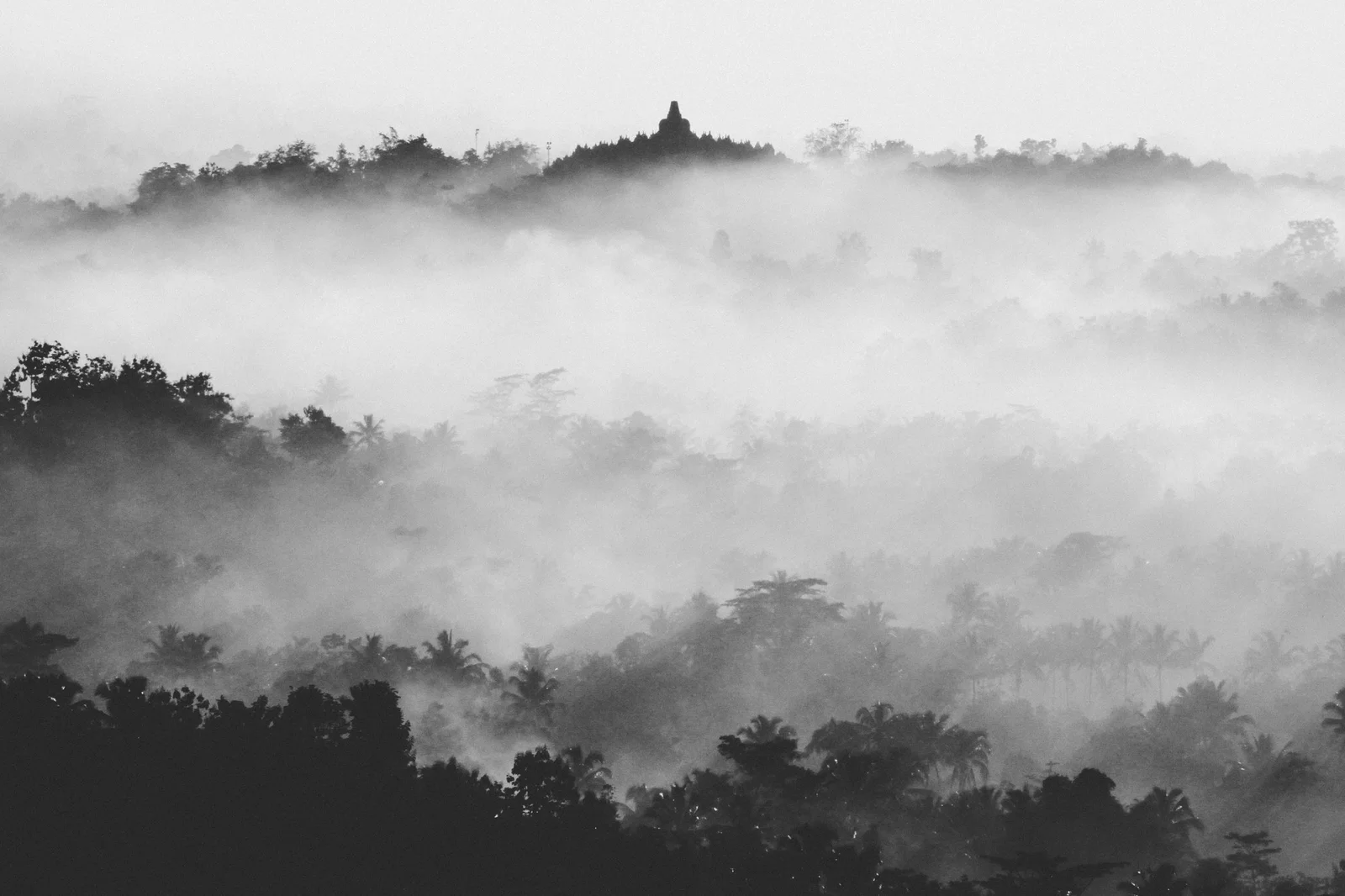
Yes, Borobudur sunrise tours are a popular and memorable way to experience the temple. These tours typically require special early morning tickets, which grant access before the general public. Watching the sun illuminate the ancient stones and the surrounding misty landscape is an experience many visitors cherish. Access rules for climbing the monument at sunrise can vary, so it’s always best to book through a reputable operator who stays updated on the latest regulations.
Ready to trace the borobudur temple history and facts in person? Planning your trip with Bali Premium Trip means a direct, transparent booking experience with our own reservations team. We arrange all the necessary third-party services, from your private transport and permits to ensuring you have a licensed local guide who can unlock the deeper stories of Borobudur. There are no third-party markups, just clear pricing and dedicated support. Reach out to us to plan your trip, or send us a WhatsApp message to start designing your bespoke Central Java adventure today.