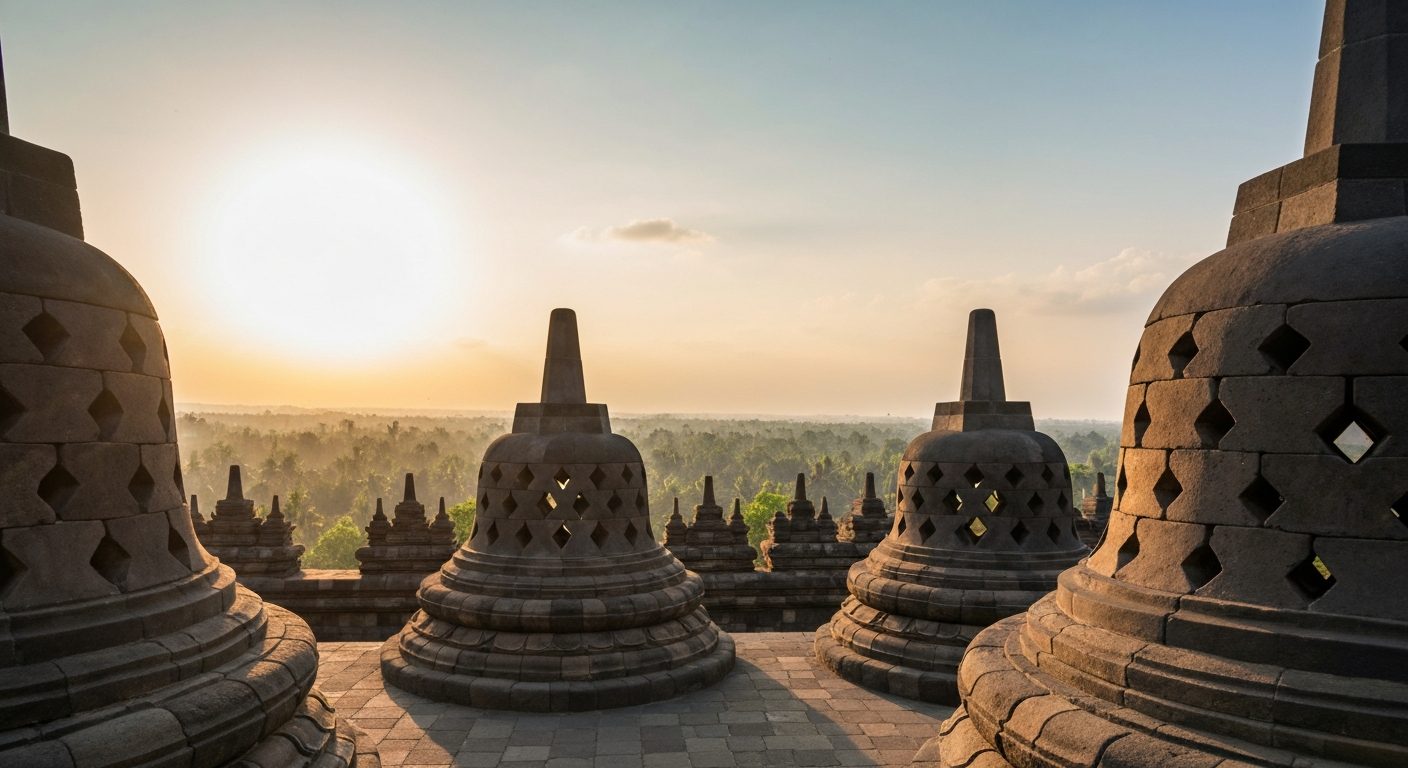
Borobudur sunrise time best viewed is roughly 05:30–05:45 all year, with the clearest light usually from June to September. The real trick is matching that sunrise time to the right viewpoint, access rules, and drive time from Yogyakarta or beyond.
I’m Dewi, and I’ve watched dawn roll over Borobudur more times than I can count — from the top terraces before the current rules, from Punthuk Setumbu hill with a thermos of coffee, and from quiet village lanes when the mist hugs the paddy fields. This guide is the practical version of everything friends ask me: when to go, where to stand, and how to avoid the common “I thought I’d be on the main stupa at sunrise” disappointment.
Borobudur sunrise time: quick facts & expectations
Borobudur sits almost exactly on the equator, so sunrise time shifts only a little throughout the year. You don’t need a complicated chart, but you do need to understand how the month and the clouds change the experience.
- Typical sunrise time
- Around 05:25–05:45 all year (civil twilight from ~04:50)
- Borobudur sunrise best time to go (season)
- Usually June–September for clearer skies and lower rain risk
- Rainier months
- October–April, with the wettest spells often December–February
- Ideal arrival at viewpoint
- At least 30–45 minutes before sunrise for hills; 60–75 minutes door-to-gate if driving from Yogyakarta
- Indicative private tour budget
- Roughly US$120–220 per person from Yogyakarta for a privately guided sunrise excursion (last verified June 2026, varies by group size and inclusions)
That’s the big picture. Next we’ll go month-by-month, including the specific borobudur sunrise time January February visitors often ask about, and how the October–April wet season actually looks on the ground.
Month‑by‑month: light, clouds, and crowds
You can catch a good sunrise any month of the year — I’ve had clear pink skies in January and a flat grey dawn in August. Still, patterns help set expectations.
Borobudur sunrise time January–February
January and February sit in the middle of the wet season. You’ll often wake to heavy clouds, overnight rain, or a lingering drizzle at dawn.
- Sunrise time: usually 05:35–05:45.
- Typical conditions: warmer, humid, high chance of morning cloud. Heavy showers are common, but often pass quickly.
- Pros: fewer sunrise crowds at Punthuk Setumbu and other hills, deep green paddies, and that magical “layers of mist” look is actually more common in the rainy months.
- Cons: higher chance of a fully overcast sky with no visible sun disk; muddy hill paths; more leeches on some forested trails.
If you’re keen on photography, think less about a dramatic orange sun and more about soft diffused light and moody silhouettes. I suggest bringing a light rain jacket, a dry bag for your camera, and footwear you don’t mind muddying.
March–May: shoulder season shifts
By March, the weather slowly begins to settle, though showers remain common, especially in the afternoon and at night.
- Sunrise time: hovering around 05:30–05:40.
- Conditions: a mix of clear mornings and hazy, cloud-draped ones. Mist in the valleys is still frequent.
- Pros: a nice balance of greenery plus a better chance of a clean horizon; still generally quieter than peak dry-season school holidays.
- Cons: humidity can be high. Paths at Punthuk Setumbu and similar viewpoints may still be slippery.
For most visitors, this is an excellent compromise period: more reliable than deep rainy season, without the full dry-season crowd pressure.
June–September: the clearest window
This is the dry season and the period I usually recommend for travellers who want the highest odds of a classic sunrise.
- Sunrise time: around 05:25–05:35.
- Conditions: cooler pre-dawn air, higher chance of clear or partly clear skies. Morning mist still appears, but tends to burn off faster.
- Pros: this is what many photographers picture: Merapi and Merbabu outlined on the horizon, Borobudur a dark silhouette in the mist, and a defined sun emerging.
- Cons: domestic school holidays (especially Eid periods and July) can make the area busier. Expect more people at key hills and around the temple.
If your calendar is flexible and you care about light more than crowd levels, target mid‑June to early July or early September rather than peak holiday weekends.
Borobudur sunrise weather October to April
From October, the pattern swings back toward the wet season. The shift doesn’t happen overnight; instead, you get more afternoon storms, which sometimes leave dramatic morning skies.
- Sunrise time: again roughly 05:30–05:40.
- Conditions: a mix of clear, hazy, and fully overcast mornings. Rain gear is sensible, especially November–February.
- Pros: if you like atmosphere — low clouds hugging the foothills, diffuse light on the temple reliefs later in the morning — this period can be very rewarding.
- Cons: you need a flexible mindset. Some mornings you simply won’t see the sun; others will reward you with a dramatic break in the clouds at the last moment.
No guide, including me, can guarantee weather or visibility. What you can control is your routing and viewpoint so that even a grey sunrise still gives you a meaningful visit.
Choosing your viewpoint: hills vs temple tiers
Most travellers planning around borobudur sunrise time best spot decisions face one main choice: do you want the iconic distance view (Borobudur as a dark silhouette in sea of mist), or do you want to be on the monument itself around sunrise time, focusing on reliefs and stupas rather than the big landscape frame?
Today, the “classic” silhouette is no longer taken from inside the temple but from the surrounding hills — especially Punthuk Setumbu. The temple’s own access system uses Tier 1/2/3 climb tickets with fixed time slots.
Punthuk Setumbu Borobudur sunrise: the classic hill view
Punthuk Setumbu is a low hill west of Borobudur village, reached by a short drive and a brief uphill walk. It remains the most popular off‑site viewpoint.
- Access: drive toward Borobudur from Yogyakarta or Magelang, then follow local signs or your guide’s route to the Punthuk Setumbu parking area.
- Walk: typically 10–20 minutes uphill on a basic path; some sections are uneven or muddy after rain.
- View: Borobudur appears as a small dark outline below, with Merapi and Merbabu on the horizon. On good days, morning mist fills the valleys.
- Facilities: simple shelters, basic warungs selling tea, coffee, instant noodles, and sometimes fried snacks; basic toilets.
To get the most from Punthuk Setumbu:
- Arrive at least 30–45 minutes before sunrise, earlier on weekends and holidays.
- Bring a headlamp or phone torch for the walk up.
- Carry a light jacket; pre‑dawn can feel surprisingly cool after an air‑conditioned car ride.
- If you’re a photographer, a mid‑range zoom (24–70mm) is usually enough; a longer lens helps compress the temple and volcanoes.
For many people, this is the best viewpoint for Borobudur sunrise photos, especially if your goal is that widely shared “temple in the mist” look.
Other hills: Punthuk Mongkrong, Gancik, and quieter options
Punthuk Setumbu isn’t alone. Several nearby hills give variations on the same theme — temple, mist, volcano silhouettes — often with fewer people.
- Punthuk Mongkrong: a bit farther and slightly higher than Setumbu. The walk-up can be steeper, and it sees fewer visitors. The composition is similar but framed differently by ridgelines and trees.
- Gancik hill area: more associated with Merapi views but offers wide horizons that work well for dawn light. From here, Borobudur is usually less prominent because of distance, so this suits travellers more interested in volcanic landscapes than the temple outline itself.
- Local micro‑viewpoints: there are small, locally named viewpoints dotting the ridges. Some are no more than a bench or bamboo platform. We sometimes use these when guests prefer quiet over the “famous” label, accepting that the iconic photos might be a little different than Instagram’s greatest hits.
These spots change in popularity over time as access is improved or land use shifts. When you plan your trip with our Bali Premium Trip team via email or WhatsApp, we match the viewpoint to your priorities that week: photography, quiet, mobility needs, or a simple “good, safe path and hot coffee at the top.”
Sunrise from Borobudur itself: Tier 1/2/3 access
The big change many older guidebooks miss: Borobudur is now managed with strict daily climb quotas and timed access to protect the stone and structure. Instead of a free‑roaming sunrise on the top terrace, you buy a Borobudur Temple Structure tour ticket in one of three tiers, each giving different access.
While exact mechanics and pricing are adjusted from time to time, here’s the practical way to think about borobudur sunrise tier 1 2 3 location options as of the latest June 2026 verification:
| Tier | Typical access | Who it suits |
|---|---|---|
| Tier 1 | Guided access to the upper terraces with a small group and tighter time window; you’ll reach the higher levels for close-up stupa and relief viewing. | Serious photographers, heritage enthusiasts, those who want to be as high as possible on the structure within the rules. |
| Tier 2 | Access to mid‑level terraces and key relief galleries with a guide, usually with slightly more flexible timing than Tier 1. | First‑time visitors who want a good balance of budget and access without needing top‑tier slots. |
| Tier 3 | Ground‑level park and courtyard access only; you see Borobudur from the base but don’t climb the upper terraces. | Visitors with mobility concerns, tight budgets, or repeat visitors who just want the ambiance and external views. |
Important context:
- The temple’s official hours do not currently include standard public sunrise access on the top terraces the way they did a decade ago. Special events exist, but they are limited and changeable.
- Morning Tier 1 and 2 climbs can still give you soft early light, but usually after the actual sunrise moment. Think 07:00 onward, not 05:30.
- All tiers use a combination of local guides and timed flow controls; you cannot simply wander up at any time and stay all day on the highest levels.
This is why most “sunrise” tours today pair a hill viewpoint at dawn with a timed temple climb later in the morning. You get both perspectives without fighting the conservation rules.
Sunrise vs sunset at Borobudur
Many people weigh borobudur sunrise vs sunset tour options. I’ll be direct: they are different experiences. One is not universally better.
Reasons to choose a sunrise‑focused trip
- Cooler air: dawn is simply more comfortable for walking, especially if you’re climbing hills or staircases.
- Iconic photographs: the classic fog‑and‑silhouette shots almost all come from sunrise, not sunset.
- Quieter temple later: if you do a hill at dawn and then the temple immediately after opening, you’ll often enter before the bulk of day‑trippers arrive from Yogyakarta.
Reasons to aim for sunset instead
- Easier wake‑up: no 02:30–03:00 alarm from Yogyakarta. You can travel at a more human hour.
- More relaxed pacing: sunset visits often combine a slow heritage walk, time in the museum, and golden‑hour photography without racing the clock.
- Weather odds: some travellers prefer to check the sky during the day and commit to sunset on the same day if it looks promising. This is easier from a closer base like Magelang.
Visually, sunset often gives warmer tones on the west‑facing reliefs and a soft backlight behind the main stupa. You usually won’t get the mist‑filled valley, but you may catch dramatic clouds and rays in the late afternoon, especially toward the wet season.
If you’re staying only one night in the area and photography is your top priority, I’d still pick sunrise on a hill plus a mid‑morning temple visit. If you’re spending longer — or really dislike early starts — a private sunset‑til‑evening heritage walk can be more enjoyable overall.
Realistic timing from Yogyakarta and Bali
The other question I hear constantly: “What time do I really have to leave?” Let’s look at the two most common starting points.
From Yogyakarta: door‑to‑dawn timing
Central Yogyakarta (Malioboro, Prawirotaman and surrounding areas) sits about 40–45 km from Borobudur. Driving time is typically 75–90 minutes in the pre‑dawn hours when traffic is light.
For a Punthuk Setumbu sunrise plus a later Borobudur visit, a realistic schedule usually looks like this:
- 02:45–03:15 – Hotel pickup in Yogyakarta.
- 03:00–04:15 – Drive toward Borobudur area.
- 04:15–04:30 – Short transfer to Punthuk Setumbu or alternative hill, then walk up.
- 05:00–06:00 – Wait through twilight and watch sunrise on the hill.
- 06:00–07:00 – Descend, simple local breakfast or coffee.
- 07:00 onward – Enter Borobudur complex for your allocated Tier 1/2/3 slot.
There’s some flexibility — for example, we can shift the coffee stop before or after the temple depending on your ticket time — but that wake‑up hour from Yogyakarta is non‑negotiable if you want to be in position before first light.
As a rule of thumb, from a city hotel in Yogyakarta you need to be ready to leave about 2 hours before civil twilight, which itself starts around 04:50. That’s how you reverse‑engineer your alarm clock.
From Bali: overnight, not a same‑morning dash
From Bali, a same‑morning Borobudur sunrise is not realistic. You’ll need to fly into Yogyakarta (or sometimes Semarang) first, then stay overnight near the temple or in the city before your early start.
Typical flow with our Bali Premium Trip team:
- Day 1: flight from Bali to Yogyakarta (commonly 1–1.5 hours air time; total airport-to-hotel journey more like 3–4 hours including transfers). Afternoon or evening at leisure in Yogyakarta or transfer straight to a hotel near Borobudur.
- Day 2: pre‑dawn departure for Punthuk Setumbu or another hill, sunrise session, then Borobudur temple visit with a licensed local guide.
As a very rough planning range, a 2‑day, 1‑night side trip from Bali to Yogyakarta for Borobudur sunrise and Prambanan with private transfers and guiding typically comes out around US$350–650 per person (last verified June 2026, depending on hotel category, flight prices, and group size). This is not a quote, just a realistic bracket so you’re not blindsided.
If you’re starting in Bali and want to thread this into a longer Java itinerary — say 3–7 days crossing from Yogyakarta toward Bromo and Ijen — our reservations team can lay out the options clearly. Just plan your trip and we’ll follow up over email or WhatsApp with route diagrams and indicative budgets.
What a private, expert‑guided sunrise trip includes
Borobudur is easy enough to reach by yourself, but a well‑planned privately guided sunrise visit removes a lot of the friction: changing rules, permits, ticket tiers, and small timing mistakes that add up.
With Bali Premium Trip, here’s how it typically works for a Borobudur sunrise‑focused tour, either from Yogyakarta or as part of a Bali-to-Java detour:
Transport and timing
- Private, air‑conditioned vehicle sized to your group (usually 2–12 guests; we arrange larger vehicles for bigger parties).
- Door‑to‑door hotel pickup and drop‑off, timed backward from sunrise and gate opening, not just generic “early.”
- Driver experienced with the Yogyakarta–Borobudur route in the dark, including back‑road options if there are roadworks or local events.
Guides, permits, and local coordination
- Licensed local guides who know the current Borobudur access rules, queue systems, and what each Tier ticket practically allows that week.
- Advance coordination of Borobudur Temple Structure access (Tier 1–3) according to your budget and interest; we arrange tickets and required permits via on‑the‑ground partners.
- Clear explanation of dress code (long trousers or skirt over the knee, covered shoulders, temple‑appropriate behaviour) and what you can and can’t take onto the terraces.
Viewpoint choice and photography support
- Selection between Punthuk Setumbu, Punthuk Mongkrong, or quieter ridges based on current ground conditions — muddy paths, local events, or temporary closures.
- On‑site tips for photographers: tripod use etiquette, suggested positions so you’re not blocked when the sun finally breaks through, and backup compositions if the sky stays flat.
- Flexible pacing after sunrise — some guests prefer extra time on the hill with coffee, others want to head straight to the temple before crowds.
You always book directly with our Bali Premium Trip reservations team at transparent, published rates. We do not apply third‑party markups; instead, we work with vetted local drivers, guides, and landowners around Borobudur and simply pass on any park or viewpoint fees as part of your agreed package.
Is Borobudur sunrise “worth it” right now?
With the older on‑stupa sunrise tickets gone and the tiered access system in place, many travellers understandably ask if getting up at 03:00 is still worth the effort.
My honest take, after guiding through the rule changes:
- Yes, if you’re ready to enjoy the experience even without a textbook orange sky. The dawn call to prayer, roosters in the villages, silhouettes of volcanoes, and that first hint of blue over the plain add up to something quietly powerful.
- Yes, if you pair it with a deeper temple visit later. The sunrise alone, from a hill, is visually impressive but not the whole story. The reliefs, Buddha statues, and layout of Borobudur need time at the monument itself.
- Maybe not, if you hate early mornings, are very sensitive to crowds, and don’t care much about photography. In that case, a carefully timed late‑afternoon or sunset heritage walk can be more comfortable.
What has changed is not the quality of the dawn light, but where you can legally stand to see it. Once you accept that the “best” view today is usually from a hill — with the temple visit as a second chapter — the experience makes sense again.
If you’d like a clear, no‑nonsense outline of options matched to your dates and starting point (Yogyakarta, Bali, or elsewhere in Indonesia), you can plan your trip with our team. We’re happy to talk through it by WhatsApp as well, sharing recent photos and current access notes so you’re not relying on outdated blog posts.
Practical tips to make your Borobudur sunrise smoother
- Clothing: light, breathable layers; something over the shoulders; long trousers or skirt. Bring a thin jacket or shawl for pre‑dawn; you may peel it off later.
- Footwear: trainers or hiking sandals with grip. Flip‑flops are a bad match for wet soil on the hills.
- Gear: headlamp or phone torch, small daypack, water, packable rain jacket in wet months, microfiber cloth for lenses (humidity can fog glass quickly).
- Money: small notes for local snacks, toilets, and optional hill access fees if not bundled in your tour.
- Mindset: plan for the experience, not a single photo. Some of my favourite mornings have been the ones where the sun never properly appeared, but the fog and birdsong made it feel otherworldly.
Is Punthuk Setumbu safe in the dark?
Yes, in normal circumstances, Punthuk Setumbu is considered safe for sunrise visitors, especially if you’re with a licensed guide and driver. Paths are basic and can be slippery, so walk carefully, use a light, and follow local instructions at the gate or from your guide.
Can I still see sunrise from the top of Borobudur?
Under current conservation rules, the classic pre‑dawn access to the highest terraces is no longer part of regular public tours. Morning Tier 1 and 2 tickets usually give access after sunrise, with soft early light but not the actual dawn moment. Special events are occasionally organised, but they are limited and subject to change.
How far is Punthuk Setumbu from Borobudur?
The hill sits only a short drive from the temple area — typically 15–25 minutes by car, depending on road conditions and traffic. From the parking area, expect a 10–20 minute uphill walk to the main viewpoint.
Is sunrise or sunset better for photos?
For the classic Borobudur-in-the-mist shot, sunrise is better because the valley tends to hold fog in the early morning and the light comes from behind the temple. Sunset works well for warm side light on reliefs and stupas and for people‑focused scenes, but you rarely get that same layered mist effect.
How far in advance should I arrange a sunrise tour?
For weekdays outside school holidays, 1–2 weeks is often enough. For peak periods and if you want specific Borobudur Tier 1 or Tier 2 slots tied to your sunrise plan, aim for 3–6 weeks. This gives our team time to secure tickets, align guides, and choose the best viewpoint for your dates.