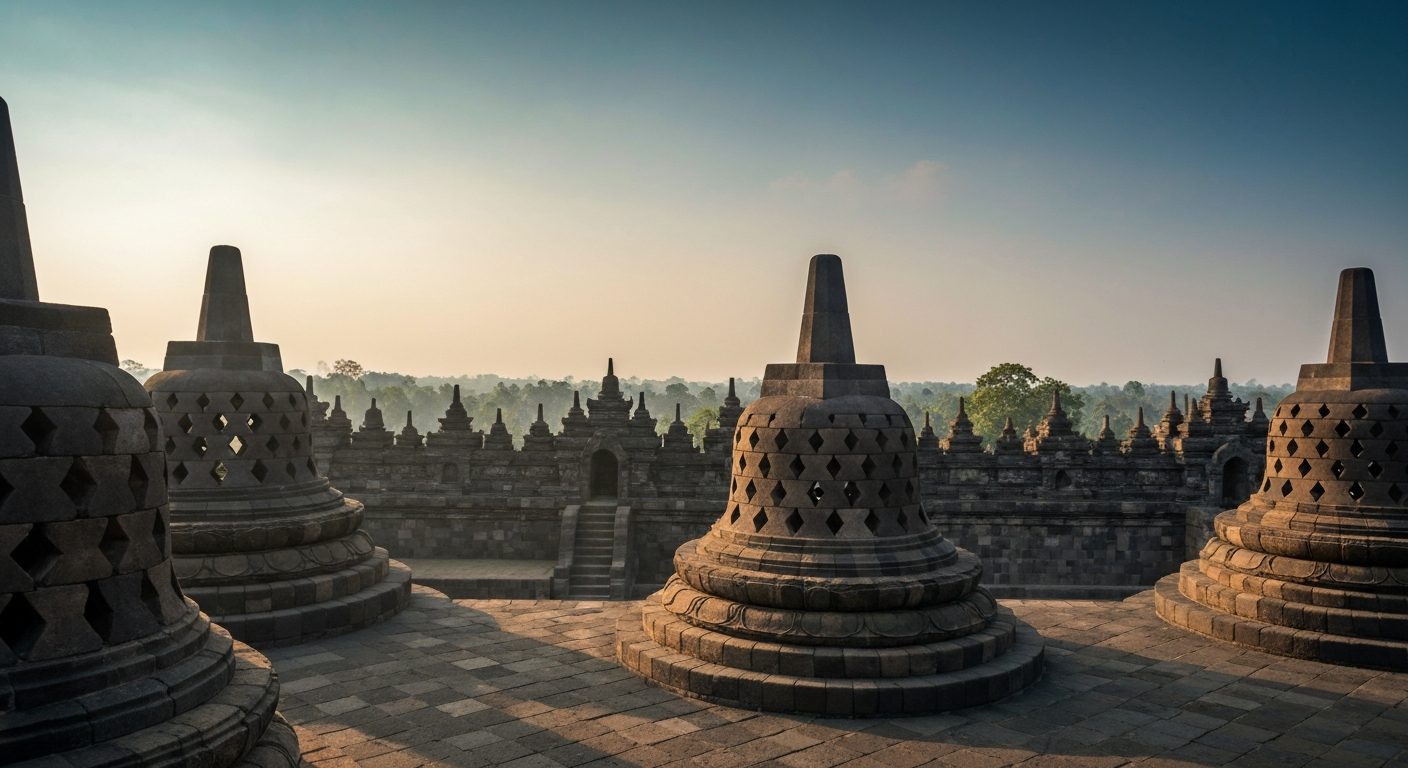
Borobudur is the world’s largest Buddhist temple and a UNESCO World Heritage site, an awe-inspiring monument that stands as a profound testament to ancient Javanese artistry and spiritual devotion. This colossal Mahayana Buddhist temple, located in Central Java, Indonesia, is not merely a structure but a journey through Buddhist cosmology carved in stone, attracting visitors from across the globe to experience its powerful serenity and intricate details.
As someone who has spent over a decade guiding and documenting visits here, from pre-dawn ascents to quiet afternoon contemplations, I can tell you that Borobudur truly is a unique experience. It’s a place that asks you to slow down, to observe, and to absorb. But planning your first visit to this magnificent site can feel a bit complex, especially with evolving access rules and the sheer volume of information out there. Let’s cut through the noise and talk about what you need to know to make your visit meaningful and straightforward.
What Makes Borobudur the World’s Largest Buddhist Temple?
The question of “why Borobudur is the largest Buddhist temple” is answered not just by its sheer size but by its profound architectural and spiritual ambition. Completed likely in the 9th century CE during the Sailendra Dynasty, Borobudur is not a building with an interior space, but rather a colossal stupa and a pilgrimage path. Its design represents the cosmos and the stages of enlightenment according to Mahayana Buddhism, making it a “textbook in stone.”
Architectural Grandeur and Scale
The Borobudur temple complex history reveals a structure built from approximately 2 million blocks of volcanic andesite stone. Its base measures an impressive 123 by 123 meters, rising to a height of 34.5 meters. The monument is comprised of nine stacked platforms: six square terraces at the base, followed by three circular platforms leading to a central dome. This unique terraced structure is what allows it to hold an incredible number of artistic and spiritual elements.
A Gallery of Buddha Statues and Reliefs
Within its vast expanse, Borobudur is home to 504 Buddha statues, each seated in a meditative pose, many originally housed within bell-shaped stupas on the upper circular terraces. More remarkably, the temple is adorned with 2,672 relief panels stretching over 3 kilometers along its galleries. These panels tell stories from Buddhist scriptures, depicting the life of Buddha, karmic law, and the path to enlightenment. It is the most complete and extensive ensemble of Buddhist reliefs in the world, making Borobudur the largest Buddhist monument in the world not just in physical footprint, but in its narrative scope.
Symbolism of the Three Realms
The structure of Borobudur is a physical representation of the Buddhist cosmology, divided into three conceptual realms:
- Kamadhatu (The World of Desire): Represented by the base of the temple, originally hidden by an outer encasement, it depicts scenes of human desire and karmic consequences. Some of these reliefs are now exposed at the southeast corner.
- Rupadhatu (The World of Forms): The five square terraces above the base, rich with narrative and decorative reliefs. Here, pilgrims walk clockwise, absorbing stories from the Lalitavistara, Jataka, Avadana, and Gandavyuha sutras, moving from the earthly to the spiritual.
- Arupadhatu (The World of Formlessness): The three circular terraces and the central stupa at the top. This realm is simpler, with fewer adornments, symbolizing the release from earthly attachments. Here, 72 small stupas, each containing a Buddha statue, encircle the main stupa.
This layered, symbolic design, combined with its monumental scale and artistic richness, firmly establishes Borobudur as a truly unique and the largest Buddhist monument in the world.
Borobudur: A UNESCO World Heritage Site in Central Java
The Borobudur UNESCO World Heritage Temple is more than just an ancient ruin; it’s a living monument to human ingenuity and spiritual aspiration. Located near Magelang, Central Java, the site offers a profound connection to Indonesia’s rich cultural and religious past.
When Did Borobudur Become a UNESCO World Heritage Site?
Borobudur was inscribed as a UNESCO World Heritage Site in 1991. Its recognition came after decades of extensive restoration efforts, primarily led by UNESCO and the Indonesian government from 1973 to 1983. This massive undertaking meticulously reassembled and reinforced the monument, bringing it back from centuries of neglect and natural degradation.
Why the UNESCO Status Matters
The inscription as a UNESCO World Heritage Site acknowledges Borobudur’s “outstanding universal value.” It recognizes the temple as a masterpiece of universal architectural and artistic achievement, representing a unique example of Buddhist architecture and sculpture. This status provides international protection and support for its preservation, ensuring that future generations can continue to experience the borobudur unesco world heritage facts and its spiritual legacy. The site is an active place of pilgrimage and a significant symbol for Buddhists worldwide, cementing its importance far beyond its geographical location.
Planning Your Borobudur Visit: Access, Tickets, & What to Expect
Visiting the Borobudur Buddhist Monument Indonesia can be an incredible experience, but it requires a bit of planning, especially regarding access and tickets. The rules have evolved over time to protect this fragile heritage.
Entrance Tickets and Costs (Last Verified June 2026, Indicative Ranges)
Ticket prices for Borobudur vary significantly based on your nationality and what kind of access you seek. It’s always best to check the official Borobudur Park website for the most current information, but here are general ranges:
Foreign Visitors
-
Daytime Entry (Ground Level Access):
- Adults: US$25-30 per person.
- Children (6-10 years old): US$15-20 per person.
- Children under 6: Free.
This ticket typically grants access to the temple complex grounds and the lower levels of the monument. You can walk around the base and admire the first few terraces.
-
Sunrise/Stupa Climb Ticket (Special Access):
- Historically, this was around US$45-55 per person.
Important Note on Stupa Access: Direct climbing to the upper stupa levels of Borobudur has been significantly restricted since 2022 to protect the monument from wear and tear. Currently, climbing the actual monument, especially to the upper circular terraces and stupas, usually requires a special ticket, often bundled with a licensed guide and specific time slots. These tickets are limited daily. We highly recommend booking a guided tour through Borobudur Package (operated by Bali Premium Trip) to ensure you have the correct access and an expert guide to navigate the current rules. This special access often includes a sarong, and sometimes a light breakfast or hot drink.
Local Visitors (Indonesian Citizens)
-
Daytime Entry:
- Adults: IDR 50,000-75,000 per person.
- Children: IDR 25,000-40,000 per person.
- Sunrise/Stupa Climb Ticket: Often a separate, higher-priced ticket with similar restrictions as foreign visitors.
What Your Ticket Gets You:
A standard daytime ticket allows you to enter the park, explore the grounds, and walk around the base of the Borobudur structure. You can view the reliefs from the ground level and ascend the monument up to a certain point, typically the square terraces, depending on current regulations. For the truly immersive experience of walking among the stupas at the very top, a special, guided access ticket is required. This is where an experienced local guide is invaluable, not just for interpretation but for ensuring you have the correct permissions.
Dress Code and Etiquette
Modest dress is required for all visitors to Borobudur, as it is a sacred site.
- Sarong and Sash: You will be provided with a sarong and sash at the entrance if your clothing is deemed inappropriate (e.g., shorts or skirts above the knee, sleeveless tops). Many tour packages, including those arranged by Borobudur Package, will include this.
- Recommended Attire: It’s best to wear comfortable, breathable clothing that covers your shoulders and knees. This saves time and ensures respect for the site.
- Footwear: Comfortable walking shoes are a must, as you’ll be doing a lot of walking and climbing stairs.
- Respectful Behavior: Remember that Borobudur is a place of worship. Speak softly, avoid climbing on fragile structures, and follow your guide’s instructions.
Best Time to Visit Borobudur UNESCO Site Magelang
The temple opens at 6:00 AM for regular daytime visitors and closes around 5:00 PM. Sunrise visits typically start much earlier, around 4:00 AM or 4:30 AM, to catch the first light.
- Sunrise: Watching the sunrise over Borobudur, with mist often clinging to the surrounding fields and volcanoes in the distance, is an iconic experience. It’s truly magical, but also the most crowded. If you opt for sunrise, be prepared for an early start and many other people. The restricted access to the upper levels for sunrise makes it even more exclusive and special.
- Late Afternoon: A quieter alternative is to visit in the late afternoon. The light is beautiful, and the crowds are generally thinner. You can enjoy a more peaceful exploration as the day cools down.
- Mid-morning/Mid-day: This is typically the hottest and busiest time. While still impressive, the heat can be intense, and the crowds can detract from the serene atmosphere.
Getting to Borobudur: Routes from Yogyakarta & Bali
Borobudur is located approximately 40 kilometers northwest of Yogyakarta, in the Magelang Regency of Central Java. For those traveling from Bali, the journey involves a bit more planning.
From Yogyakarta (Yogyakarta or Solo)
Yogyakarta is the most common gateway city for Borobudur.
- By Car/Taxi: The easiest and most comfortable way to get to Borobudur is by private car or taxi. The drive takes about 1 to 1.5 hours, depending on traffic. You can hire a car with a driver for a half-day or full-day trip, which is ideal for combining Borobudur with other nearby attractions like Prambanan Temple. Borobudur Package can arrange this for you with a licensed local driver.
- By Public Bus: Less convenient but budget-friendly. Take a TransJogja bus to Jombor Terminal, then transfer to a local bus heading to Borobudur. This can be time-consuming and less comfortable, especially for early morning sunrise trips.
- Motorbike Rental: For adventurous solo travelers, renting a motorbike is an option. Ensure you have international driving permits and are comfortable with Indonesian traffic.
From Bali
Traveling from Bali to Borobudur requires flying to Java first.
-
Flight to Yogyakarta (YIA or JOG):
- Fly from Ngurah Rai International Airport (DPS) in Denpasar, Bali, to Yogyakarta International Airport (YIA) or Adisutjipto International Airport (JOG). YIA is newer and further from the city but handles most flights. JOG is closer to the city center but has fewer flights.
- Flight duration is typically 1 to 1.5 hours.
- Upon arrival in Yogyakarta, follow the “From Yogyakarta” options above to reach Borobudur.
- Total Travel Time: From Bali, expect a minimum of 3-5 hours of travel time each way, including airport transfers, flight, and ground transport to Borobudur. This makes a day trip from Bali very long and tiring. Most visitors from Bali opt for at least an overnight stay in Yogyakarta to fully enjoy Borobudur and other Central Java sights.
Borobudur Package specializes in arranging seamless travel from Bali, including flights, airport transfers, and expert-guided tours.
Experience Borobudur with a Private, Expert-Guided Trip
To truly appreciate the borobudur unesco world heritage temple and navigate its complexities, a private, expert-guided trip is invaluable. Our approach at Borobudur Package is to provide a comprehensive, stress-free experience, allowing you to focus entirely on the spiritual and historical significance of this magnificent site.
We understand that you want an authentic, well-informed visit without any surprises. That’s why we arrange private, expert-guided trips operated by our trusted partner, Bali Premium Trip, with licensed local guides who are deeply knowledgeable about Borobudur’s history, iconography, and Mahayana Buddhist design. Our guides are not just escorts; they are storytellers who bring the 2,672 relief panels and 504 Buddha statues to life.
What a Guided Tour Offers:
- Seamless Logistics: From hotel pick-up in Yogyakarta (or airport transfer if coming from Bali) to return, we handle all transportation. No need to worry about navigating local roads or finding parking.
- Guaranteed Access: With the current restrictions on climbing the temple, having a pre-arranged tour with special access tickets is crucial for reaching the upper levels and the stupas. Our guides ensure you have the correct permits and understand the rules.
- In-Depth Interpretation: A licensed local guide provides context for the intricate carvings, explaining the narratives of the reliefs and the symbolism of the temple’s structure. This transforms your visit from a simple walk into an educational and spiritual journey.
- Optimal Timing: Our guides know the best times to visit to minimize crowds (as much as possible) and catch the most favorable light for photography, whether you choose a sunrise or a daytime visit.
- Personalized Experience: A private tour means the itinerary can be tailored to your pace and interests. Want to spend more time at a particular gallery? Have specific questions about Buddhist philosophy? Your guide is there for you.
- Comfort and Convenience: We arrange all third-party services, such as park jeeps if needed for other nearby sites, and ensure your comfort throughout the trip.
Booking Your Trip with Borobudur Package (Operated by Bali Premium Trip)
When you plan your trip with Borobudur Package, you are booking directly with our own Bali Premium Trip reservations team. We offer transparent, published rates with no third-party markup. This direct relationship ensures clear communication, reliable service, and the peace of mind that comes from working with a dedicated team. We arrange all necessary permits, licensed local guides, and comfortable transport, ensuring a smooth and enriching experience.
For example, a comprehensive full-day guided tour from Yogyakarta, including private car, driver, licensed Borobudur guide, and entrance tickets (daytime access, potentially with special access to upper levels if available and booked), typically ranges from US$150-250 per person for a private tour (based on 2 people, last verified June 2026, indicative and varies by inclusions and season). This indicative range provides a comfortable and informed way to see the temple, ensuring you get the most out of your visit without worrying about the details.
Ready to experience the largest Buddhist temple in the world with expert guidance? Plan your trip to Borobudur with us today. Our team is available via WhatsApp to help tailor your perfect itinerary.
Comparison of Borobudur with Other Major Temples
To truly grasp the significance of Borobudur, it’s helpful to compare it briefly with other renowned temple complexes.
- Borobudur (Indonesia)
-
Type: Mahayana Buddhist monument.
Construction Period: 8th-9th century CE.
Key Features: Nine stacked platforms, 504 Buddha statues, 2,672 relief panels depicting Buddhist cosmology and stories. A colossal stupa rather than a temple with interior spaces. Largest Buddhist monument. - Prambanan (Indonesia)
-
Type: Hindu temple complex (Trimurti).
Construction Period: 9th century CE.
Key Features: Group of over 200 temples dedicated to Brahma, Vishnu, and Shiva. Tall, slender architecture and intricate carvings of Hindu deities and epics. Largest Hindu temple complex in Indonesia. - Angkor Wat (Cambodia)
-
Type: Hindu (later Buddhist) temple.
Construction Period: 12th century CE.
Key Features: Massive complex, moat, five iconic towers. Extensive bas-reliefs depicting Hindu myths and historical events. Largest religious monument by land area.
Borobudur stands out for its unique mandala-like structure, its overwhelming number of narrative reliefs, and its pure dedication as a single, monumental stupa representing the path to enlightenment. It is the largest Buddhist temple by volume of stone and carved surface dedicated to a single Buddhist narrative, rather than sheer land area.
Frequently Asked Questions About Borobudur
What is the significance of Borobudur?
Borobudur holds immense significance as the world’s largest Mahayana Buddhist temple and a UNESCO World Heritage site. It is a monumental expression of Buddhist cosmology, depicting the path to enlightenment through its nine stacked platforms, 504 Buddha statues, and 2,672 narrative relief panels. It served as a pilgrimage site and a center for learning, reflecting the high artistic and spiritual achievements of the Sailendra Dynasty in 9th-century Central Java.
How many Buddha statues are at Borobudur?
Borobudur features a total of 504 Buddha statues. Many of these are seated within the 72 bell-shaped perforated stupas on the upper circular terraces, while others are openly displayed on the square terraces below. Each statue typically displays a different mudra (hand gesture), corresponding to various directions and stages of meditation.
Can you climb to the top of Borobudur?
Access to the very top stupa levels of Borobudur has been restricted since 2022 to protect the monument from the wear and tear of millions of visitors. While you can still access the general temple complex and walk around the lower terraces, direct climbing to the upper circular platforms and stupas typically requires a special ticket, often bundled with a licensed guide and specific time slots. These special access tickets are limited daily, so booking through an authorized operator like Borobudur Package (operated by Bali Premium Trip) is recommended to secure your chance to experience the upper levels.
What should I wear to Borobudur?
Visitors to Borobudur should wear modest clothing that covers their shoulders and knees, as it is a sacred site. If your attire is deemed inappropriate (e.g., shorts or skirts above the knee, sleeveless tops), you will be provided with a sarong and sash at the entrance, which must be worn during your visit. Comfortable walking shoes are also highly recommended due to the extensive walking and stair climbing.
How far is Borobudur from Yogyakarta?
Borobudur is located approximately 40 kilometers (about 25 miles) northwest of Yogyakarta. The journey by private car or taxi usually takes about 1 to 1.5 hours, depending on traffic conditions. Yogyakarta serves as the primary gateway city for visitors to Borobudur.
I hope this honest overview helps you plan your visit to this incredible Borobudur UNESCO World Heritage Temple. It’s a journey well worth making, and we are here to help make it seamless. When you’re ready to experience the majesty of Borobudur firsthand, with an expert guide to illuminate its stories, plan your trip with Borobudur Package. Our team is ready to assist you via WhatsApp.