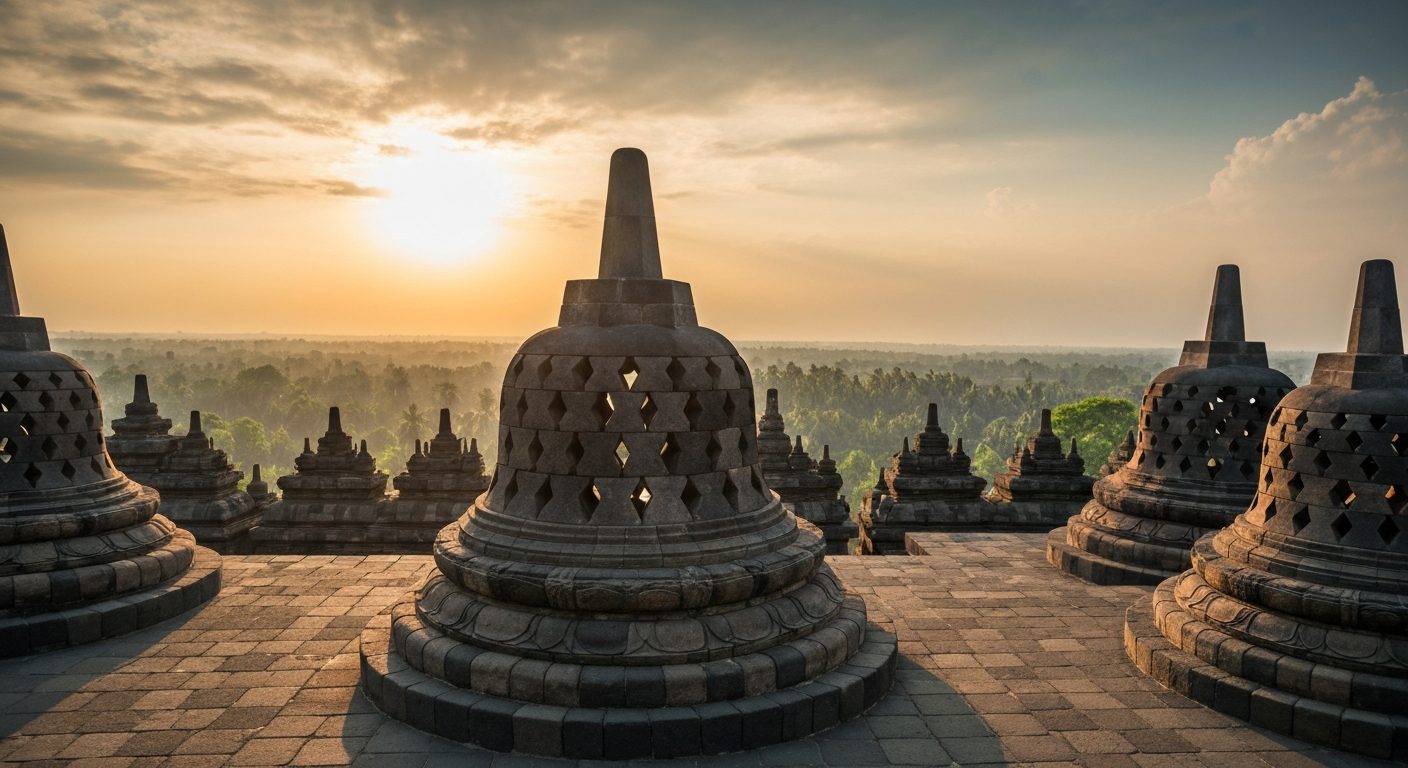
Learning effective Borobudur photography tips is essential for any visitor hoping to capture the magic of this ancient monument. As someone who has spent over a decade documenting and guiding visits here, from pre-dawn ascents to quiet afternoon walks, I’ve seen countless sunrises paint the stupas in gold and watched travelers struggle – or succeed – in translating that experience into a memorable image. This guide shares the honest version: what works, what doesn’t, and how to truly “see” Borobudur through your lens, not just snap a picture.
Borobudur isn’t just a collection of impressive structures; it’s a profound narrative told in stone. Your camera can be a tool for capturing its beauty, but also for understanding its story. We’ll cover everything from the best photography tips for Borobudur sunrise to understanding the temple’s access rules, ensuring your Borobudur temple photos tell a rich, meaningful story.
Understanding Borobudur’s Access & Restrictions for Photography
Before you even think about camera settings or angles, it’s crucial to understand the rules. Borobudur is a living heritage site and a place of worship, carefully managed by the UNESCO World Heritage Centre. These rules are in place to preserve the temple and ensure a respectful experience for all. Ignoring them can lead to disappointment at the gate or even fines.
Ticket Tiers and Climb Rules: What You Can Actually Photograph
The way you access Borobudur directly impacts your photography opportunities, especially regarding the upper terraces. In recent years, access regulations have evolved to protect the temple’s structure from erosion caused by heavy foot traffic.
Currently, there are typically two main tiers of tickets for foreign visitors:
- Standard Entrance Ticket (Ground Level Access)
- This ticket allows you to enter the temple complex and photograph the monument from its base and surrounding park areas. You can walk around the four lower terraces, capturing wide shots of the temple, its intricate base reliefs, and the surrounding landscape. You cannot ascend the main structure beyond a certain point, usually the first or second terrace. This is perfect for capturing the overall grandeur and the detailed carvings at eye-level.
- Temple Climb Ticket (Upper Level Access)
- This specialized ticket, often limited in number and requiring a licensed guide, grants you access to ascend to the upper circular terraces and stupas. This is where you get those iconic close-up shots of the bell-shaped stupas and the panoramic views over the plains. These tickets are usually time-slot specific, have strict duration limits (e.g., one hour on the upper levels), and require you to wear special sandals provided by the management to protect the stone. This is essential for capturing the best photography tips for Borobudur sunrise from the upper levels.
It’s vital to check the latest regulations before your visit. Borobudur Package, operated by Bali Premium Trip, can provide the most current information on ticket availability and help arrange tours that include temple climb access. A comprehensive private Borobudur day tour, including transport, entry tickets, and a licensed guide, can range from US$150-350 per person (last verified June 2026), depending on group size and specific inclusions, and often includes the option to add the temple climb ticket.
Drone Use and Other Gear Limits
Borobudur is a no-drone zone for general visitors. Period. The rules are very strict, and flying a drone without explicit, difficult-to-obtain permits from multiple government agencies is prohibited. Attempting to do so will result in confiscation and potential legal trouble. Do not bring a drone expecting to fly it.
Beyond drones, consider the following:
- Tripods: Generally allowed on the ground level but can be cumbersome in crowds, especially during sunrise. On the upper temple levels (with a climb ticket), tripods might be restricted due to space and safety concerns. Check with your guide.
- Flash Photography: Not allowed inside any of the temple structures or close to the reliefs, as it can damage the ancient stone. Rely on natural light.
- Reflectors/Diffusers: Small, handheld ones might be fine, but anything large or disruptive is discouraged.
- Commercial Photography: Requires special permits and fees. If you’re shooting for personal use, you’re generally fine.
Respect the rules. They’re there to protect a 9th-century masterpiece.
Mastering Borobudur Sunrise Photography
The Borobudur sunrise is legendary for a reason. Watching the mist lift from the Kedu Plain as the sun bathes the stupas in soft light is an experience many travelers seek. Capturing it well requires planning and patience. This is where the best photography tips for Borobudur sunrise truly come into play.
Best Vantage Points for Sunrise
Your vantage point depends entirely on whether you have a temple climb ticket or are viewing from the ground.
- From the Upper Temple Terraces (with climb ticket): This is the quintessential Borobudur sunrise experience.
- The Main Stupa Terrace: The highest circular terrace offers panoramic views. Position yourself to capture the main stupa and the smaller bell-shaped stupas with the rising sun behind them, or illuminating them from the side.
- Eastern Side: For direct shots of the sun ascending, face east. The light here is pure and direct.
- Western Side: Don’t neglect the west! As the sun rises in the east, the western face of the temple and the stupas will be beautifully illuminated, offering warm, soft side lighting.
- Framing: Use the smaller stupas as foreground elements to add depth to your wide shots of the sun. Look for the famous “bell-shaped stupas framing Mount Merapi” shot, though clear views of Merapi are not guaranteed daily due to haze.
- From the Ground Level or Surrounding Park: If you don’t have a temple climb ticket, or prefer a different perspective.
- Manohara Hotel/Garden: Directly adjacent to the temple, this area offers good ground-level views.
- Punthuk Setumbu Hill: Located about 4-5 km west of Borobudur, this famous viewpoint offers a distant, elevated perspective of the temple emerging from the mist. You’ll need to arrange separate transport (often a local jeep) to get here before dawn. This is a classic shot, but remember the temple will appear smaller.
- “Chicken Church” (Gereja Ayam): Another nearby hill offering a unique, slightly quirky viewpoint.
Camera Settings for Golden Hour
Sunrise photography is all about managing dynamic range – the difference between the bright sky and the darker temple and foreground.
- Aperture: Start with an aperture around f/8 to f/11 for a good depth of field, ensuring both the foreground elements (like stupas) and the distant sky are in focus.
- Shutter Speed: This will vary significantly. In very low light before the sun breaks, you might need longer exposures (1/15th to 1 second or more, requiring a steady hand or tripod). As the sun rises, your shutter speed will increase rapidly. Use a fast shutter speed (e.g., 1/250s or faster) for sharp images of people or details.
- ISO: Keep your ISO as low as possible (e.g., ISO 100-400) to minimize noise, especially in low light. Only increase it if necessary to achieve a usable shutter speed.
- White Balance: Set your white balance to “Cloudy” or “Shade” to enhance the warm, golden tones of the sunrise. “Daylight” or “Auto” can sometimes make the scene appear too cool.
- Exposure Bracketing: This is your best friend. Shoot 3-5 bracketed exposures (e.g., -2, 0, +2 EV) to capture detail in both the highlights (bright sky) and shadows (dark temple). You can later merge these in post-processing for a perfectly exposed image.
- Composition: Look for leading lines, use the rule of thirds, and frame the temple with foreground elements like trees or the bell stupas. The repeating patterns of the stupas and the surrounding landscape offer endless compositional possibilities.
Capturing the Temple’s Architecture: Angles and Perspectives
Beyond sunrise, Borobudur’s architecture offers rich photographic opportunities throughout the day. The sheer scale and intricate details make it a fascinating subject for any photographer. This section focuses on finding the Borobudur best photography location angle.
The Three Tiers: From Base to Stupas
Borobudur is built in a mandala-like structure, symbolizing the Buddhist cosmology. This tiered design offers distinct photographic challenges and rewards.
- The Base (Kamadhatu): This level, much of which is covered, represents the world of desire. What’s visible are the intricate base reliefs. For wide shots of the entire structure, stand a good distance back, allowing the temple to dominate the frame against the sky. Use a wide-angle lens (16-35mm equivalent) to capture its breadth.
- The Rectangular Terraces (Rupadhatu): These four square terraces are adorned with thousands of narrative reliefs. Here, focus on the details. Move close to the walls, looking for interesting perspectives where the reliefs stretch into the distance. The repeating patterns of the Buddha statues in their niches also make for compelling shots.
- The Circular Terraces and Stupas (Arupadhatu): The three upper circular terraces feature 72 bell-shaped stupas, each containing a Buddha statue, culminating in the large central stupa. This is where you get iconic shots.
- Leading Lines: Use the curved railings and the lines of stupas to draw the viewer’s eye towards the central stupa or the horizon.
- Patterns: The geometric repetition of the stupas creates powerful patterns. Look for angles where multiple stupas align or create interesting visual rhythm.
- Close-ups: Focus on the intricate lattice work of the stupas and the serene faces of the Buddha statues within.
Finding Your Borobudur Best Photography Location Angle
The “best” angle is subjective, but here are some tried-and-true approaches:
- The Grand Sweep: From the ground level, step back to get the entire temple in your frame. Try shooting from slightly off-center to add dynamic tension. A wide-angle lens is key here.
- Stupa Silhouettes: During sunrise or sunset, silhouette the smaller stupas against the vibrant sky. This creates a dramatic, minimalist image.
- Framing with Nature: Use the lush trees and tropical foliage in the surrounding park to frame parts of the temple, adding context and a sense of place.
- Details within Details: Don’t just shoot wide. Zoom in on the unique carvings, the texture of the stone, or the expressions on the Buddha statues. These intimate shots tell a different story.
- Human Element (Respectfully): Sometimes, including a person (from a distance, or a back shot) can give a sense of scale to the massive temple. Always be mindful and respectful of other visitors.
- Reflections: After a rain shower, look for puddles that can offer interesting reflection opportunities, doubling the visual impact of the temple.
Dealing with Crowds and Haze
Borobudur is a popular destination, so crowds are almost inevitable, especially during sunrise. Haze is also common, particularly during the dry season or early mornings.
- Crowd Management:
- Arrive Early/Stay Late: For sunrise, arriving well before dawn gives you a better chance to stake out a spot. Similarly, visiting an hour or two before closing can offer quieter moments.
- Look Up: Often, the crowds are at eye level. By pointing your camera upwards, you can minimize the number of people in your frame, focusing on the stupas or upper architecture against the sky.
- Focus on Details: When wide shots are impossible due to crowds, shift your focus to the intricate reliefs or architectural elements.
- Long Exposure (with tripod): If allowed and practical, a long exposure shot (e.g., 30 seconds) can make moving crowds “disappear,” leaving only the stationary temple structure. This is an advanced technique and requires a tripod and ND filter.
- Haze Reduction:
- Shoot Early: The air is often clearest just after sunrise.
- Post-Processing: Use editing software to enhance contrast, clarity, and dehaze your images.
- Focus on Close-ups: When distant views are obscured by haze, concentrate on the closer architectural details and reliefs.
Borobudur Reliefs Photography: Telling Stories in Stone
The true heart of Borobudur lies in its bas-relief panels, which stretch for over 2.5 kilometers along its galleries. These aren’t just decorative; they are a visual encyclopedia of Buddhist teachings and Javanese life. For meaningful Borobudur temple photos, understanding these narratives is key. This is your guide to Borobudur temple relief carvings meaning.
There are broadly three main narrative series:
- Karmawibhangga (Law of Karma): Found on the base of the temple (often covered, but accessible in one section on the east side), these reliefs depict the consequences of good and bad actions. They are vivid, sometimes graphic, illustrating the karmic cycle.
- Lalitavistara (Life of Buddha): Located on the first gallery, this series tells the story of Prince Siddhartha Gautama’s life, from his birth to his first sermon. These are rich in detail, showing his miraculous birth, renunciation, enlightenment, and early teachings.
- Jataka and Avadana (Tales of Previous Lives): Spread across the upper galleries, these reliefs recount stories of the Buddha’s previous incarnations (Jataka tales) and other virtuous deeds (Avadana). They illustrate moral lessons and the path to enlightenment.
Tips for Photographing Intricate Carvings
Capturing the detail and narrative power of the Borobudur reliefs photography requires a deliberate approach.
- Lighting is Key:
- Early Morning/Late Afternoon: The low angle of the sun during these times creates beautiful shadows that enhance the depth and texture of the carvings. Midday sun can flatten the reliefs, making them harder to distinguish.
- Side Lighting: Look for reliefs where the light hits them from the side, revealing contours and details.
- Lens Choice: A prime lens (e.g., 50mm) or a telephoto zoom (e.g., 70-200mm) allows you to isolate specific panels and fill the frame with detail, minimizing distractions. A macro lens could be used for extremely close-up textural shots if desired.
- Focus Precisely: Ensure your focus is sharp on the relief itself. Use a small aperture (f/8 to f/11) to maximize depth of field across the carving’s surface.
- Composition:
- Isolate Panels: Rather than trying to capture a whole section, focus on individual panels that tell a complete story or have particularly striking imagery.
- Look for Repetition: The reliefs often feature repeating motifs or figures. Use this repetition to create visually interesting compositions.
- Read the Story: Before you shoot, take a moment to understand what the relief depicts. Your photograph will be more impactful if you know the meaning.
- Post-Processing: Enhance clarity and contrast to bring out the details. A slight increase in sharpness can also be beneficial. Convert to black and white to emphasize texture and form, especially on faded reliefs.
Borobudur Temple Relief Carvings Meaning
Understanding the meaning adds immense depth to your photography. Think of these reliefs as ancient comic strips, each panel advancing a narrative.
- Karmawibhangga: As you walk the base, observe scenes of people experiencing the consequences of their actions – heaven for the virtuous, hell for the wicked. Look for depictions of generosity, greed, violence, and compassion.
- Lalitavistara: Follow the life of Prince Siddhartha. You’ll see his mother Maya’s dream, his birth from her side, his royal upbringing, his encounters with old age, sickness, and death, his departure from the palace, his ascetic practices, and finally, his enlightenment under the Bodhi tree.
- Jataka/Avadana: These tales often feature animals or ordinary people demonstrating virtues like self-sacrifice, wisdom, and patience. Look for recurring figures or symbolic animals (elephants, monkeys) that play key roles in these moral fables.
A licensed local guide, which Bali Premium Trip can arrange for your visit, is invaluable for interpreting these stories. They can point out specific panels and explain their significance, transforming your photography from mere documentation into a visual commentary on ancient wisdom.
Essential Borobudur Photography Tips Camera Settings Beyond Sunrise
While sunrise is iconic, Borobudur offers incredible shots throughout the day. Adapting your camera settings to the changing light is crucial for a complete Borobudur photography guide UNESCO temple experience.
Daytime Exposure
Midday sun can be harsh, creating strong contrasts and blown-out highlights.
- Exposure Compensation: You might need to dial down your exposure compensation (-0.3 to -0.7 EV) to protect the highlights in the sky and on the bright stone.
- Shutter Speed: Will be fast (e.g., 1/500s or faster) to freeze any movement and prevent overexposure.
- Aperture: Still aim for f/8 to f/11 for general landscape and architectural shots to maintain sharpness across the frame.
- ISO: Keep it at your camera’s base ISO (e.g., 100 or 200) for maximum image quality.
- Polarizing Filter: A circular polarizer (CPL) filter is highly recommended for daytime. It reduces glare from the stone, deepens blue skies, and enhances contrast, making colors more vibrant.
- Shoot RAW: Always shoot in RAW format. This gives you much more flexibility in post-processing to recover details from shadows and highlights, adjust white balance, and fine-tune colors.
Low Light & Interior Shots (if applicable/allowed)
Borobudur does not have significant “interior” spaces in the traditional sense, but some areas under overhangs or within the covered base reliefs might be darker.
- High ISO Performance: If shooting in very low light (e.g., before sunrise, or in very cloudy conditions), be prepared to increase your ISO (e.g., 800-3200). Know your camera’s limits for acceptable noise.
- Wider Aperture: If you need more light and don’t require extreme depth of field, open your aperture (e.g., f/2.8 or f/4) to let in more light, allowing for faster shutter speeds.
- Image Stabilization: Use lenses with image stabilization (IS or VR) or cameras with in-body image stabilization (IBIS) to help get sharper shots at slower shutter speeds.
- No Flash: As mentioned, flash photography is prohibited and unnecessary. Rely on available light.
Gear Recommendations
While you don’t need a professional setup, having the right tools helps.
- Camera Body: A DSLR or mirrorless camera offers the most control and image quality. Even modern smartphones can capture good Borobudur temple photos with the right technique.
- Lenses:
- Wide-angle (16-35mm equivalent): For grand architectural shots and landscapes.
- Standard Zoom (24-70mm equivalent): A versatile all-rounder for most situations.
- Telephoto Zoom (70-200mm equivalent): Excellent for isolating details, compressing perspective, and capturing reliefs.
- Accessories:
- Extra Batteries: You’ll be shooting a lot, especially if you arrive for sunrise.
- Large Memory Cards: RAW files take up space.
- Lens Cleaning Kit: Dust and humidity are factors.
- Rain Cover: For your camera and bag, just in case.
- Comfortable Shoes: You’ll be walking a lot!
Remember the Borobudur photography tips restrictions – no drones, be mindful of tripods, and never use flash on the reliefs.
Making Your Borobudur Temple Photos Stand Out: Composition & Story
Anyone can take a picture of Borobudur. The goal is to create Borobudur temple photos that resonate and tell a story.
- Seek Unique Perspectives: Instead of always shooting straight on, try low angles, high angles (if permitted), or frame the temple through foliage. Look for leading lines in the architecture or the paths.
- Embrace the Weather: Don’t let a cloudy day deter you. Overcast light can be beautiful for reliefs, offering soft, even illumination. Fog or mist can add an ethereal, mysterious atmosphere.
- Focus on the Details: The grand sweeps are important, but the true character of Borobudur often lies in its smaller elements – the intricate carvings, the serene faces of the Buddhas, the textured stone.
- Capture the Human Element (Respectfully): Sometimes, a lone figure appreciating the temple, or a monk in contemplation (from a distance and without intrusion), can add a powerful narrative to your images, giving a sense of scale and presence. Always be discreet and respectful.
- Tell a Narrative: If you’re photographing the reliefs, try to capture a sequence that tells a part of the Buddha’s story or a Jataka tale. Think of your photo series as a visual journey through the temple’s teachings.
- Patience is a Virtue: Wait for the light, wait for a gap in the crowds, wait for a moment of quiet reflection. The best shots often come to those who are patient.
Planning Your Borobudur Photography Guide UNESCO Temple Visit
To maximize your photography opportunities and ensure a smooth experience, planning is essential.
- Timing:
- Sunrise: For the iconic golden hour shots. Requires an early start (often leaving Yogyakarta around 3:30-4:00 AM).
- Late Afternoon: For softer light, fewer crowds (after 3 PM), and potentially beautiful sunset hues.
- Avoid Public Holidays/Weekends: These times see the heaviest crowds. Weekdays are generally quieter.
- Local Guide: A licensed local guide is not just for interpretation of the Borobudur temple relief carvings meaning; they can also help navigate crowds, advise on the best routes, and inform you of any real-time changes to access rules. Borobudur Package (operated by Bali Premium Trip) specializes in arranging such expert guides.
- What to Wear: Modest clothing is respectful and often required (shoulders and knees covered). Comfortable shoes are a must.
- Stay Hydrated: Central Java can be hot and humid. Bring water.
- Check Forecasts: While weather is never guaranteed, having an idea helps you plan.
Borobudur is more than just a site; it’s an experience. Let your photography reflect that depth. It’s a Borobudur photography guide UNESCO temple journey that rewards thoughtful engagement.
Ready to capture your own iconic Borobudur temple photos? Let us help you plan your trip. Our team at Bali Premium Trip arranges comprehensive, private tours with licensed local guides, ensuring you get the most out of your visit. From managing early morning logistics to providing in-depth insights into the temple’s history and photography rules, we take care of the details.
Frequently Asked Questions
What are the current photography restrictions at Borobudur Temple?
Drone use is strictly prohibited for general visitors without extensive permits. Flash photography is not allowed on or near the reliefs. Tripods may be restricted on the upper temple levels, especially during crowded times. Always be respectful of other visitors and sacred spaces.
What is the best time of day for Borobudur photography?
Sunrise is renowned for its soft, golden light and the atmospheric mist. Late afternoon (an hour or two before closing) also offers beautiful light and often fewer crowds, ideal for capturing details of the reliefs and the overall architecture. Midday light can be harsh but can be managed with proper camera settings.
Do I need a special ticket to photograph the upper levels of Borobudur?
Yes, to ascend to the upper circular terraces and stupas, you typically need a specific “Temple Climb Ticket,” which is often limited in availability and requires accompaniment by a licensed guide. Standard entrance tickets usually only permit photography from the ground level and lower terraces.
How can I best capture the Borobudur temple relief carvings meaning in my photos?
Focus on individual panels during early morning or late afternoon when side lighting enhances depth. Use a telephoto lens to isolate details. Before shooting, take a moment to understand the narrative (e.g., Karmawibhangga, Lalitavistara, Jataka) depicted in the carvings. A licensed guide can greatly enhance your understanding and photographic storytelling.
What gear should I bring for Borobudur photography?
A camera with interchangeable lenses (wide-angle for landscapes, telephoto for details), extra batteries, plenty of memory cards, and a lens cleaning kit are essential. A circular polarizing filter is highly recommended for daytime shots. Consider a lightweight tripod if allowed and if you plan to do long exposures, but be aware of potential restrictions.
For a personalized Borobudur photography adventure, contact our reservations team directly via WhatsApp at +6281128590000 or plan your trip through our website. We are operated by Bali Premium Trip and look forward to assisting you.