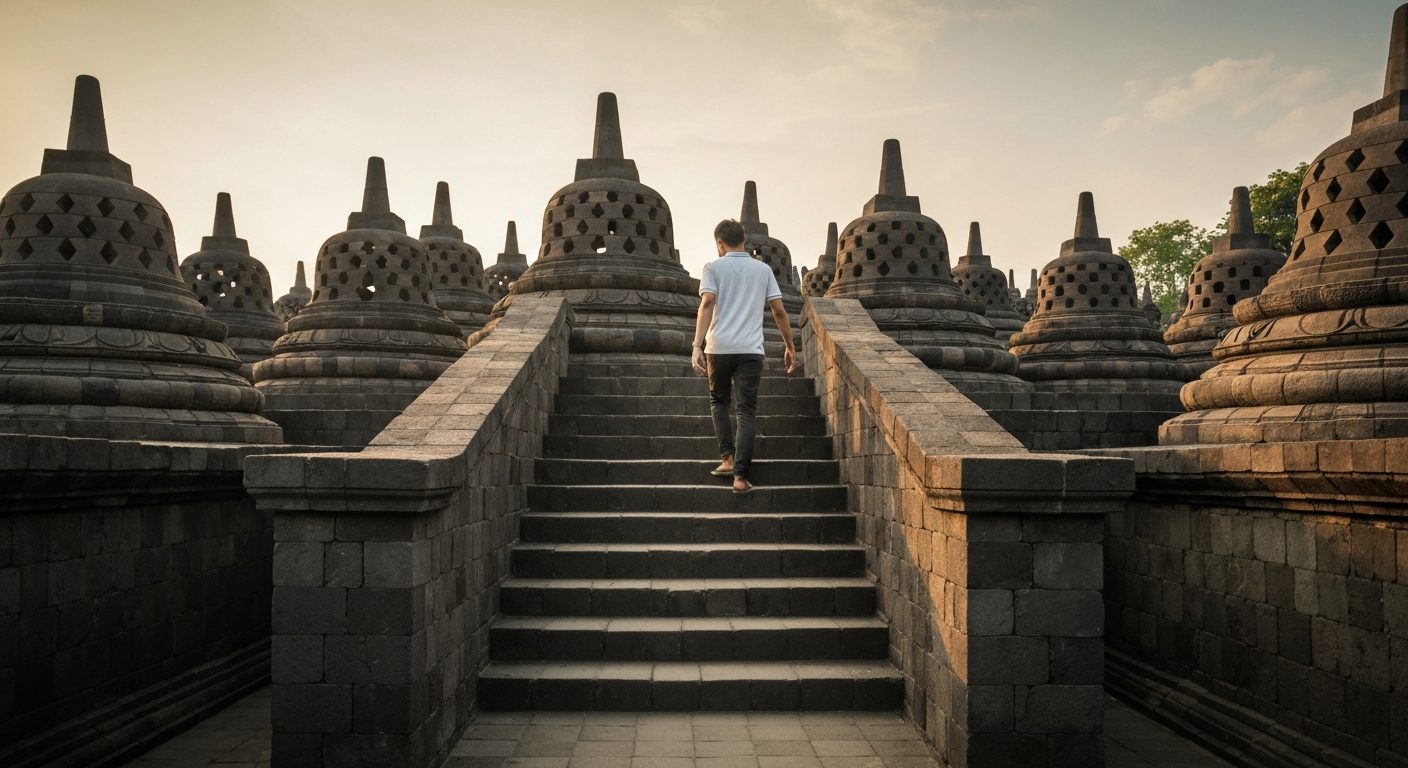
Understanding the Borobudur climb difficulty steps is crucial for planning your visit to this magnificent temple. While the journey to the top offers incredible rewards, it’s wise to know exactly what the physical requirements are and how to navigate the ancient structure. This guide, straight from my own experiences chasing the sunrise across Borobudur’s levels, will give you the honest truth about the Borobudur temple climb — from the new regulations to what it truly feels like underfoot, ensuring you set realistic expectations for your adventure.
Borobudur is an extraordinary place, a deeply spiritual site that has stood for centuries. My goal here isn’t to discourage you, but to prepare you. I’ve seen countless visitors arrive, some delighted, some surprised by the physical demands or the access rules. Let’s make sure you’re in the former group, ready to soak in every moment.
The Borobudur Climb: What to Expect Today
Visiting Borobudur is no longer a free-for-all stroll to the summit. Over the past few years, the site authority has implemented a structured-climb system designed to protect the monument’s delicate stone and manage visitor flow. This means your experience will be different from what older guidebooks or online forums might describe.
Mandatory Structured Climb System
To climb the main temple structure beyond the base platforms, you’ll need to adhere to specific rules:
- Timed-Slot Tickets: Access to the upper levels is now strictly controlled by timed entry slots. This helps limit the number of people on the monument at any given time, preserving the experience and the structure itself. These slots can fill up quickly, especially during peak season or sunrise hours, so advance booking is essential.
- Capacity Limits: A daily cap on visitors climbing the monument is in place. This translates directly to the availability of those timed-slot tickets. If you arrive without a pre-booked slot, you might find yourself limited to viewing the temple from the ground level.
- Mandatory Upom Rubber Sandals: Forget your flip-flops or hiking boots for the climb itself. All visitors ascending the structure must wear provided “Upom” rubber sandals. These are designed to be soft on the ancient stone, preventing wear and tear from hard soles. They are usually collected at a designated point before you start your ascent.
- Licensed Guide Requirement: For the structured climb, a licensed local guide is mandatory. This isn’t just for historical context – though their insights are invaluable. The guides also ensure visitors follow the rules, stay on designated paths, and maintain respectful behavior on the sacred monument. They help pace your ascent and descent.
- Designated Routes: You won’t be free to wander every single corridor or step. Specific routes are marked for ascent and descent to manage flow and minimize impact.
These regulations mean your visit needs careful planning. Spontaneity is charming, but for Borobudur’s upper levels, preparation is paramount.
Breaking Down the Steps: How Physically Demanding is Borobudur?
The borobudur physical fitness requirements aren’t extreme, but they do exist. It’s not a mountain trek, but it’s certainly more than a flat walk. Think of it as climbing a multi-story building via wide, ancient stairs – some of which are quite steep.
Actual Step Counts and Stupa-Level Terrain
Borobudur rises in nine ascending platforms: six square terraces and three circular ones, crowned by a central stupa.
- Base to Summit: From the ground level (the park around the temple) to the very top circular platform, you’re looking at approximately 500-600 steps. This number varies slightly depending on your exact path and whether you count every single riser.
- Terrace Levels: Each of the square terraces involves climbing several flights of steps to reach the next level. The steps themselves are made of volcanic stone, often worn smooth over centuries. They can be uneven in height and depth, and some are quite narrow.
- Step Dimensions: The individual steps are generally wide enough for one person to comfortably place their foot, but their rise (height) can be inconsistent, especially on the lower, older sections. Some risers are taller than modern stairs, requiring a bit more effort.
- Vertical Ascent: The temple stands approximately 35 meters (115 feet) tall from its base to the top of the central stupa. This elevation gain is distributed across the numerous steps.
- Stupa Levels (Circular Platforms): Once you reach the circular platforms, the terrain changes. Here, you’ll find flat, open areas where the 72 smaller stupas are arranged. Walking these levels is much easier, a gentle stroll, often around the stupas themselves. This is where you can catch your breath and enjoy the panoramic views.
Pacing and Rest Points
A guided climb, particularly with a private guide arranged by Bali Premium Trip, allows for a flexible pace. You can stop frequently to admire the reliefs, take photos, or simply rest. There are no benches directly on the steps, but the flat sections of the terraces offer natural pauses.
My advice: take your time. This isn’t a race. The beauty of Borobudur isn’t just at the top; it’s in the journey, in observing the intricate carvings and feeling the history under your feet.
- Total Steps (approx. base to summit):
- 500-600 steps
- Temple Height (approx.):
- 35 meters (115 feet)
- Number of Main Platforms:
- 9 (6 square, 3 circular)
- Average Climb Duration (guided, moderate pace):
- 60-90 minutes for ascent and descent (excluding time spent at the top)
- Footwear Requirement for Climb:
- Mandatory provided Upom rubber sandals
Accessibility for All: Navigating Borobudur with Limited Mobility
The question of Borobudur accessibility wheelchair access is a critical one, and it requires an honest answer. Borobudur is an ancient monument, not designed with modern accessibility standards in mind.
What Wheelchair/Walker Users Can and Cannot Reach
- Ground Level & Park: The surrounding park area leading up to the temple’s base is generally flat and paved, making it accessible for wheelchairs and walkers. You can get very close to the base of the monument, offering impressive views of its scale and grandeur.
- Base Platform: The very first, wide base platform of Borobudur is also accessible. There are ramps that can take you up to this level. From here, you can explore the lowest reliefs and get a sense of the temple’s circumference.
- Beyond the Base: This is where the challenge begins. To ascend to the first square terrace and beyond, you must climb steps. There are no ramps, elevators, or lifts available for the upper levels.
- Wheelchair/Walker Limitations: Unfortunately, wheelchairs and walkers cannot be used to climb the main temple structure. The uneven, steep, and sometimes narrow steps simply do not permit it.
Concrete Workarounds for Limited Mobility
While a full summit climb might not be possible for everyone, a visit to Borobudur can still be deeply rewarding.
- Courtyard-Level and Base-Platform Viewing: Many visitors with limited mobility choose to experience Borobudur from the accessible ground level and the wide base platform. The views from here are still magnificent, allowing you to appreciate the monument’s architecture, its size, and the surrounding landscape. You can spend hours studying the intricate lower reliefs.
- Slow-Pace Private Timing: If you have some mobility but fatigue easily, a private tour arranged through Bali Premium Trip is invaluable. Your licensed guide can tailor the pace to your needs, incorporating frequent rest stops, choosing less steep sections where possible, and allowing ample time for ascent and descent. This is particularly helpful for Borobudur senior citizen tour options.
- Assistance: If you can manage some steps with assistance, your travel companions or guide can offer a steadying hand. However, be realistic about the number of steps and the sustained effort required.
It’s important to be honest with yourself and your travel companions about physical capabilities. The goal is to enjoy the experience, not to push beyond safe limits.
Borobudur with Children, Elderly, or Fear of Heights
Planning a Borobudur tour with elderly or children requires a slightly different approach. And for those with a Borobudur tour if afraid of heights, there are considerations too.
Traveling with Young Children
- Stroller Access: Strollers are not practical on the actual temple steps. They can be used in the surrounding park and up to the base platform, but beyond that, children must walk or be carried.
- Carriers: For very young children, a baby carrier (front or back) is the best option if you plan to climb. Ensure you are comfortable carrying them for an extended period, especially on uneven steps.
- Engagement: Keep children engaged by pointing out the reliefs, telling stories about the carvings, or letting them spot different animals depicted. A good guide will know how to make the history come alive for younger visitors.
- Pace and Breaks: Plan for a slower pace and more frequent breaks than you might otherwise. Children, especially toddlers, can tire quickly on steps.
Elderly Parents and Senior Citizens
- Pacing is Key: As mentioned, a private guide who can set a slow, comfortable pace is a game-changer. There’s no rush.
- Rest Points: Utilize the flat terraces as natural rest stops.
- Handrails (Limited): Handrails are not present on all sections of the ancient steps. Where they exist, they are often simple ropes or temporary structures. Rely more on a steady walking stick or the arm of a companion.
- “Climbing Borobudur ancient steps tips”: Advise elderly travelers to wear comfortable, non-slip shoes (even though they’ll switch to Upom sandals, comfort before and after is important), bring a small bottle of water, and communicate any discomfort immediately.
- Partial Climb Options: It’s perfectly fine to only climb to the first or second terrace and enjoy the views from there. The experience doesn’t have to be an all-or-nothing summit attempt.
Fear of Heights (Vertigo)
- Open-Air Climb: The steps are open-air, with no enclosed sections. This can be a pro or con depending on the individual.
- Wide Terraces: The square terraces are quite wide and offer a sense of security. You are not walking on narrow ledges.
- Central Stupa: As you ascend, the view expands, but you are always walking on a substantial stone structure, not a flimsy walkway. The central stupa provides a focal point.
- Focus on Details: If heights are an issue, try focusing on the intricate carvings and reliefs on the walls as you climb, rather than looking outwards too much. Your guide can help divert your attention.
- Ground-Level Option: Remember, viewing Borobudur from the ground and base platform is still an incredibly powerful experience. There is no shame in choosing this option if a full climb causes undue anxiety.
Planning Your Trip: Routes from Yogyakarta or Bali
Borobudur is located near Magelang, Central Java, approximately an hour’s drive northwest of Yogyakarta. While it’s a Java destination, many travelers arrive via Bali.
From Yogyakarta (The Easiest Route)
Yogyakarta (often abbreviated to Jogja) is the natural gateway to Borobudur.
- Travel Time: The drive from Yogyakarta city to Borobudur usually takes 1 to 1.5 hours, depending on traffic.
- Options:
- Private Car with Driver: This is the most convenient and flexible option. You can leave at your desired time (essential for sunrise), have direct transport, and your driver waits for you.
- Public Bus: Cheaper, but less convenient and much slower. Not recommended for sunrise visits.
- Motorbike Rental: For experienced riders, but consider the early morning dark and potentially unfamiliar roads.
- Private Tour: This is where Bali Premium Trip excels. We arrange private cars, licensed guides, and manage all your tickets and timing, ensuring a seamless experience from your hotel in Yogyakarta.
From Bali (Requires More Planning)
If you’re starting from Bali, your journey will involve a flight.
- Flight to Yogyakarta: You’ll need to fly from Denpasar (DPS) to Yogyakarta (YIA). Flight time is approximately 1 hour.
- Arrival at YIA: Yogyakarta International Airport (YIA) is about 45 minutes to an hour southwest of Yogyakarta city.
- Connecting to Borobudur: From YIA, you’ll then need ground transport to Borobudur.
- Overnight Stay: It’s almost always recommended to spend at least one night in Yogyakarta if you’re coming from Bali, especially if you want to experience the Borobudur sunrise. Trying to do it as a single-day return trip from Bali is extremely rushed and exhausting.
- Bali Premium Trip’s Role: We can arrange your full itinerary, from flights between Bali and Java, airport transfers, hotel stays in Yogyakarta, and of course, your private Borobudur tour with a local guide. This takes the stress out of coordinating multiple elements.
We pride ourselves on offering comprehensive solutions. Your private tour with Bali Premium Trip means one point of contact for all these arrangements, making your trip stress-free.
Making Your Borobudur Journey Smooth with Bali Premium Trip
Navigating Borobudur’s evolving access rules, managing logistics, and ensuring a comfortable experience for everyone in your group can be complex. This is precisely where Borobudur Package, operated by Bali Premium Trip, comes in. We specialize in crafting tailored Borobudur experiences.
Why Choose a Private, Expert-Guided Trip?
- Licensed Local Guides: Our guides are not just historians; they are storytellers who bring Borobudur to life. They understand the nuances of the site, know the best angles for photography, and are adept at pacing a tour to your group’s specific needs. For those concerned about how many steps to climb Borobudur or looking for climbing Borobudur ancient steps tips, your guide is your best resource.
- Paced Itinerary: We work with you to create an itinerary that suits your physical fitness levels and interests. Whether you want a slow, meditative climb, extra time for photography, or a focus on specific reliefs, your private guide will adapt. This is particularly beneficial for Borobudur senior citizen tour options or families with young children.
- The Right Ticket Type: We handle all ticket bookings, ensuring you get the correct timed-slot tickets for the structured climb, within the daily capacity limits. This eliminates stress and potential disappointment on arrival.
- Seamless Logistics: From comfortable, air-conditioned private transport from your hotel in Yogyakarta or airport transfers from YIA, to coordinating your mandatory Upom sandals and guide, we manage every detail.
- Honest Advice: Just like this guide, we provide candid, realistic advice on what to expect, helping you avoid surprises and make the most of your visit. We’ll discuss your group’s mobility, interests, and preferences to build the perfect trip.
Our indicative pricing for a private, expert-guided day trip to Borobudur from Yogyakarta, including private transport, licensed guide, and Borobudur entrance tickets (excluding flights if coming from Bali), typically ranges from US$150-300 per person. This range depends on factors like group size, specific inclusions (e.g., sunrise access, additional temple visits like Prambanan), and the season. This was last verified in June 2026. Please note that prices for temple access and guide services are subject to change by the site authority.
Remember, details change. Borobudur’s access rules, ticket caps, and operational procedures are actively managed by the site authority and can be updated. It’s always best to confirm current climb rules and ticket caps with us before you travel to ensure you have the most up-to-date information for your trip.
Ready to experience Borobudur without the guesswork? Let’s talk about your ideal visit.
Plan your trip with us today via our website or directly through WhatsApp. Our team at Bali Premium Trip is ready to arrange a journey that fits you perfectly.
FAQs
Can I climb Borobudur without a guide?
No, under the current structured climb system, a licensed local guide is mandatory for all visitors wishing to ascend the main temple structure beyond the base platform. This rule helps protect the monument and ensures a safe, informative visit.
Are there elevators or ramps to reach the top of Borobudur?
No, Borobudur is an ancient structure with no modern elevators or ramps for ascending the main temple levels. Access to the upper terraces and stupa levels is exclusively via the ancient steps, which can be steep and uneven.
How long does it take to climb to the top of Borobudur?
The actual climb to the top of Borobudur, at a moderate pace with a guide, typically takes about 30-45 minutes for ascent and another 30-45 minutes for descent. This doesn’t include time spent exploring the terraces, admiring reliefs, or taking photos at the summit, which can add another hour or more to your visit on the monument itself.
Do I need to wear special shoes to climb Borobudur?
Yes, all visitors climbing the main temple structure are required to wear provided “Upom” rubber sandals. These are designed to be gentle on the ancient stone and are typically collected at a designated point before you begin your ascent.
Can I visit Borobudur if I use a wheelchair?
Yes, you can visit the Borobudur site and explore the surrounding park and the temple’s wide base platform in a wheelchair. However, wheelchair access is not available for climbing the main temple steps to the upper levels due to their ancient, uneven nature. Many visitors still find the ground-level experience deeply rewarding.