A Borobudur photography tour offers a unique opportunity to capture the grandeur of this ancient marvel, particularly during the magical sunrise hours. This guide delves into everything you need to know to plan a successful Borobudur photography package, from securing the best angles to understanding access rules and costs, ensuring your first-time visit isn’t marred by surprises at the gate.
Borobudur Temple, a 9th-century Mahayana Buddhist monument, stands as a UNESCO World Heritage site, a sprawling complex of stone and spirituality in Central Java. Capturing its intricate reliefs, stupas, and the iconic main dome, especially as the sun paints the sky, requires careful planning. As your guide, Dewi Larasati, I’ve seen countless sunrises over Borobudur. I’ll share what truly makes for a memorable shoot, what to expect, and how Bali Premium Trip can arrange a private, expert-guided experience tailored for photographers.
Planning Your Borobudur Sunrise Photography Tour
The allure of Borobudur at dawn is undeniable. Mist often clings to the surrounding Kedu Plain, and the rising sun illuminates the temple’s volcanic stone in hues of gold and amber. A well-planned Borobudur sunrise photography tour focuses on maximizing this ephemeral light.
Optimal Sunrise Lighting Windows and Timing
The “golden hour” for photography at Borobudur is typically within 30-45 minutes of the actual sunrise. This is when the light is softest, and the long shadows add depth and drama to your compositions.
- Pre-dawn (around 4:00 AM – 5:00 AM): This is when you’ll be making your way to your chosen vantage point. The sky transitions from deep indigo to soft blues, offering opportunities for silhouette shots against the pre-dawn glow.
- Sunrise (around 5:30 AM – 6:00 AM, varies by season): This is the moment the sun breaks the horizon. If you’re on a hill, you’ll see the temple emerge from the mist. If you’re on the temple itself, the light will begin to illuminate the eastern side.
- Post-sunrise Golden Hour (6:00 AM – 7:00 AM): The light continues to be warm and directional, perfect for highlighting the temple’s textures and intricate carvings. This period also often sees the mist beginning to dissipate, revealing more of the surrounding landscape.
To truly capture the essence, aim to be in position at least 45 minutes before the official sunrise time. This allows you to set up your gear, adjust to the low light, and scout your initial compositions.
Borobudur Photography Location Angle: Choosing Your Vantage Point
Selecting the right Borobudur photography location angle is crucial for distinct images. There are two primary approaches: viewing the temple from a distance (typically a hill) or photographing it from within its terraces. Each offers different compositional opportunities.
Punthuk Setumbu Sunrise Photography Spot
For many, the classic Punthuk Setumbu sunrise photography spot is the quintessential choice. Located about 4 kilometers (roughly 2.5 miles) west of Borobudur Temple, this relatively small hill offers a panoramic view of the temple complex emerging from the morning mist, often framed by the backdrop of Mount Merapi and Mount Merbabu.
- Access: You typically arrive by car or scooter, then take a short, moderate hike (about 15-20 minutes) up a paved path to the viewing platforms. Local guides or drivers usually arrange the entry tickets (separate from the main temple ticket).
- Best Angles: From Punthuk Setumbu, you can capture wide-angle shots of the entire temple complex, emphasizing its scale against the natural landscape. The rising sun often appears behind or to the side of the temple, creating dramatic backlighting or side-lighting. Look for compositions that include the “chicken church” (Gereja Ayam) in the foreground for added interest, or focus on the layers of mist and distant volcanoes.
- Timing: Arrive by 4:00 AM to secure a good spot on the viewing platform, especially during peak season.
Punthuk Mongkrong
An alternative to Punthuk Setumbu, Punthuk Mongkrong offers a similar, slightly different perspective. It’s often less crowded than Setumbu, providing a more serene experience for your shoot. The view of Borobudur from Mongkrong can feel a little more distant, but still allows for grand landscape compositions.
- Access: Similar to Setumbu, it involves a drive and a short walk.
- Best Angles: Good for wide-angle shots, especially for capturing the temple within its broader natural context. The orientation might offer slightly different light angles depending on the time of year.
Borobudur Temple Upper Terraces and Stupa-and-Mist Compositions
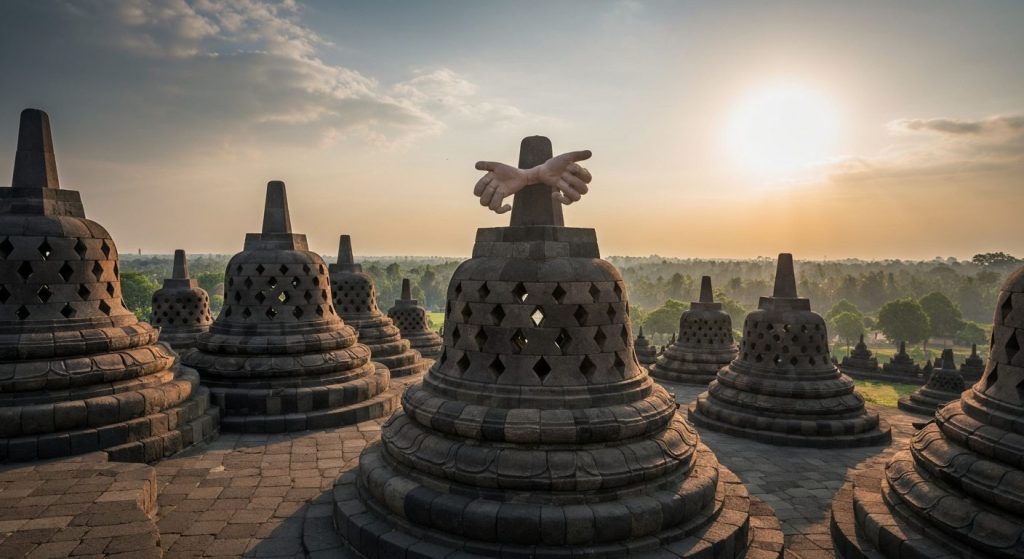
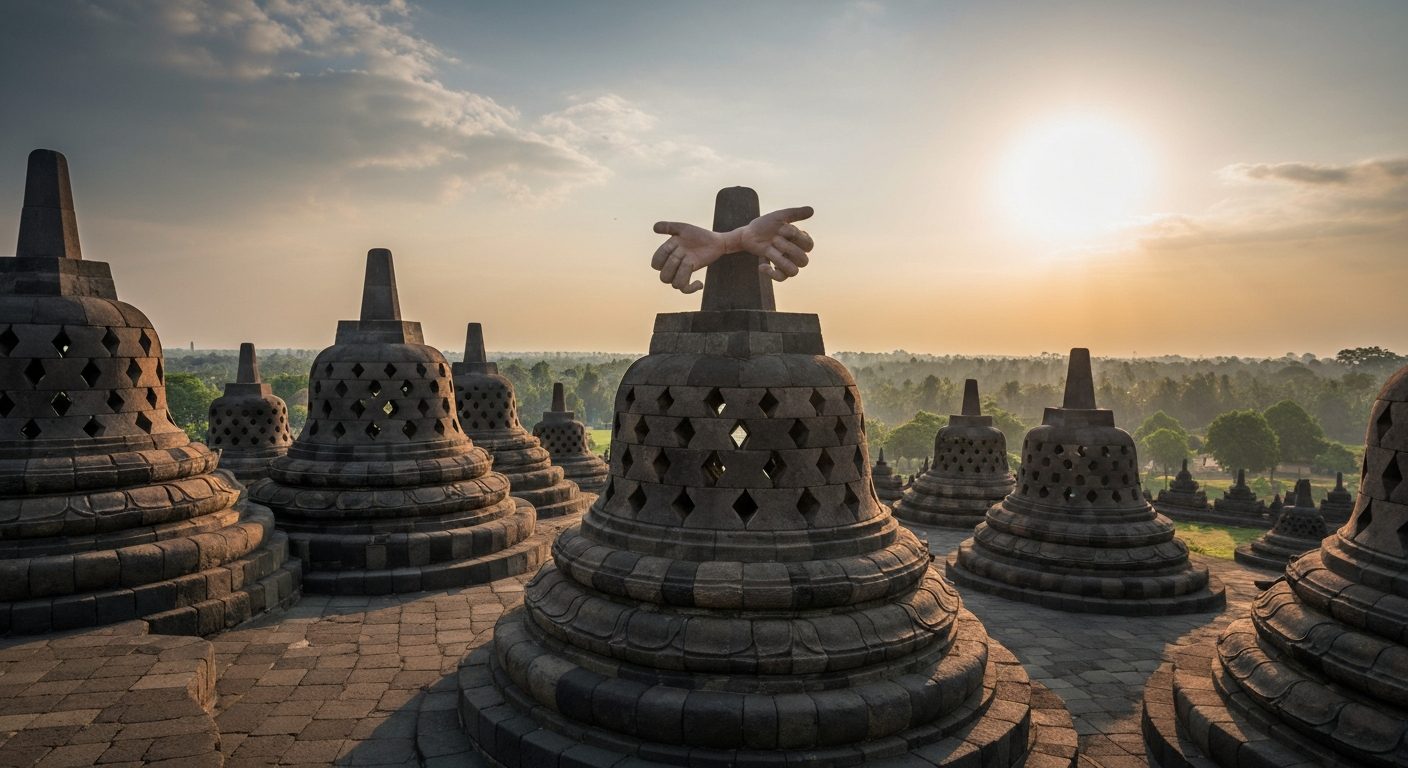
Directly accessing the temple for sunrise offers an intimate perspective. This is where you can achieve those iconic Borobudur best photography angle composition shots: the bell-shaped stupas silhouetted against the dawn sky, the intricate relief carvings catching the first light, or the mystical stupa-and-mist compositions as the fog rolls through the lower levels.
- Access: Sunrise entry to the temple itself requires a special ticket, which is distinct from the regular daytime park entrance. These tickets are limited, and access to the upper terraces (levels 8 and 9) is generally permitted only with a licensed local guide and for a limited duration.
- Best Angles:
- Level 8 (Circular Terraces): This level, with its numerous bell-shaped stupas, offers incredible opportunities. Focus on individual stupas, framing them against the sky or using the sunrise colors as a backdrop. Look for the “hand of Buddha” emerging from stupa latticework.
- Level 9 (Main Stupa): While direct access to the very top might be restricted or time-limited, the area around the main stupa offers views over the lower terraces. This is prime for capturing the geometric patterns of the stupas receding into the mist or the jungle canopy.
- Relief Panels: As the sun rises, the side-lighting can dramatically highlight the details of the narrative relief panels on the lower square terraces (Kamadhatu and Rupadhatu levels).
- Considerations: With restricted numbers and guided access, you’ll need to be efficient with your shots. Movement is often controlled, so planning your desired compositions beforehand is key.
Borobudur Best Photography Location Angle: Combining Views
For a truly comprehensive Borobudur photography tour, consider combining a hill vantage point (like Punthuk Setumbu) with an on-temple shoot. This usually means two separate sunrise outings on consecutive mornings, as fitting both into a single sunrise window is practically impossible due to travel time and access restrictions.
- Day 1: Punthuk Setumbu for the grand, panoramic sunrise shot.
- Day 2: Temple climb for the intimate, detail-focused stupa and relief shots.
Bali Premium Trip can help arrange such a multi-day photography focused itinerary, ensuring smooth transfers and guided access for both experiences.
Borobudur Photography Permit Requirements and Gear Guidance
Understanding the rules around photography gear and permits is crucial to avoid issues at the gate.
Photography Permit Requirements for Professional Gear
Park management policies regarding photography equipment can change. As of our last verification in June 2026, general smartphone and small camera photography for personal use does not require special permits. However, specific rules apply for:
- Tripods: While small, portable tripods might sometimes be overlooked, using a full-sized tripod, monopod, or any professional-grade stabilization equipment on the temple grounds often requires a special permit and may incur an additional fee. This is especially true for temple climbs. Our local partners will arrange this for you.
- Drones: Drone use within the Borobudur Temple area is generally highly restricted or outright prohibited without explicit, often difficult-to-obtain, commercial permits from multiple government bodies. We strongly advise against planning drone photography unless you have secured all necessary official permits well in advance, and even then, local regulations are subject to change without prior notice.
- Commercial Shoots: Any photography intended for commercial purposes (e.g., stock photography, advertising, film) requires a separate, more extensive permit process and significant fees, which must be approved by the park authority.
Important Note: Bali Premium Trip arranges, but does not issue, these official permits. We work with our licensed local partners who facilitate the application process with the park authorities on your behalf. It is essential to communicate your specific gear and photography intentions to our reservations team well in advance so we can advise on the latest requirements and arrange the necessary paperwork.
Recommended Gear for Your Borobudur Photography Tour
- Camera Body: A reliable DSLR or mirrorless camera with good low-light performance is ideal.
- Lenses:
- Wide-angle lens (16-35mm equivalent): Essential for capturing the vastness of the temple from a distance (e.g., from Punthuk Setumbu) or for grand compositions on the temple terraces.
- Mid-range zoom lens (24-70mm or 24-105mm equivalent): Versatile for general shots, group photos, and street photography.
- Telephoto lens (70-200mm or longer): Useful for compressing the landscape, isolating distant features like volcanoes, or capturing details on the temple if you’re shooting from a hill.
- Tripod: (As mentioned, permit required for professional use on temple grounds). Crucial for sharp low-light shots, long exposures, and HDR bracketing, especially before sunrise.
- Remote Shutter Release: Reduces camera shake for long exposures.
- Extra Batteries: Cold mornings can drain batteries faster.
- Memory Cards: Bring plenty of storage.
- Headlamp or Flashlight: Absolutely essential for navigating in the dark before sunrise.
- Rain Cover: For your camera and bag, as tropical weather can be unpredictable.
- Lens Cleaning Cloths: For dew or mist.
Golden-Hour Guidance for Photographers
- Exposure Bracketing: The dynamic range of a sunrise scene can be challenging. Use exposure bracketing (taking multiple shots at different exposures) to capture detail in both highlights and shadows. This is especially useful for HDR (High Dynamic Range) post-processing.
- White Balance: While auto white balance is often good, experimenting with “daylight” or “cloudy” presets can yield warmer tones. Shooting in RAW will give you maximum flexibility in post-processing.
- Composition:
- Rule of Thirds: Position key elements (the sun, a stupa, the horizon) along the intersecting lines or points.
- Leading Lines: Use the temple’s balustrades, stairs, or rows of stupas to lead the viewer’s eye into the frame.
- Silhouettes: Before the sun fully rises, create dramatic silhouettes of stupas or even people against the colorful sky.
- Framing: Use trees or architectural elements to frame the temple in your shot.
- Patience: The light changes rapidly. Be ready to adjust your settings and compositions quickly. Don’t be afraid to experiment.
Borobudur Photography Tour Cost and Inclusions
A private Borobudur photography tour is designed for flexibility and to maximize your photographic opportunities. Bali Premium Trip, founded in 2015 in Kuta, Bali by Agung Afif, specializes in crafting such bespoke experiences. We arrange your entire trip from start to finish, working with vetted, licensed local guides and operators on the ground in Central Java.
Indicative Tour Cost
The Borobudur photography tour cost varies significantly based on factors such as:
- Duration: A single sunrise shoot vs. a multi-day itinerary.
- Starting Point: Tours from Yogyakarta are generally less expensive than those starting in Bali due to airfare.
- Inclusions: Number of temple entries, private vehicle type, photography permits, expert guide fees, meals, and accommodation quality.
- Group Size: Private tours are more cost-effective per person for larger groups.
As of our last verification in June 2026, an indicative price range for a private, dedicated Borobudur photography package (e.g., a 2-day, 1-night itinerary focusing on two sunrise shoots, one from a hill and one from the temple, including transfers from Yogyakarta, all entry tickets, a professional photography guide, and basic accommodation) might range from US$350 to US$700 per person. This is a broad range, and a single sunrise tour from Yogyakarta (without accommodation) would naturally be at the lower end. Extended tours starting from Bali, including flights and more comprehensive guiding, could push this higher.
What these costs generally cover (when arranged by Bali Premium Trip):
- Private Air-Conditioned Transfers: From your accommodation in Yogyakarta (or from Yogyakarta airport) to Borobudur and any hill vantage points. If starting from Bali, this includes flights to Yogyakarta and airport transfers.
- Licensed Local Guide: An English-speaking guide with knowledge of Borobudur’s history and an understanding of photographers’ needs.
- Borobudur Temple Entry Tickets: Includes standard park entry and the special sunrise entry ticket for temple climbing (when chosen).
- Hill Vantage Point Entry: Tickets for Punthuk Setumbu or Punthuk Mongkrong.
- Photography Permits: Assistance in arranging any required permits for tripods or professional gear, as per park regulations (additional fees may apply for the permit itself).
- Meals: Often includes breakfast after sunrise, and sometimes other meals depending on the package.
- Accommodation: For multi-day tours, arrangements for local hotels or guesthouses.
What is typically NOT included (unless specified):
- International or domestic flights to/from Indonesia (if not starting from Bali).
- Personal travel insurance.
- Tips for guides and drivers.
- Personal expenses, snacks, or drinks beyond what’s specified.
- Any highly specialized or commercial photography permits that require extensive government approval.
Borobudur Temple Photography Guide: Rules and Etiquette
To ensure a smooth and respectful visit, remember these guidelines when photographing Borobudur:
- Respect the Sacred Space: Borobudur is a place of worship and immense historical significance. Act respectfully. Keep your voice down, avoid running, and do not climb on stupas or statues.
- Dress Code: Modest dress is required. Knees and shoulders must be covered. Sarongs are often provided at the entrance or are available for rent, but it’s best to come prepared.
- Guided Access: Access to the upper terraces of Borobudur is currently restricted and only permitted with a local guide and special tickets. This helps manage visitor numbers and preserve the delicate structure. Your guide will ensure you adhere to the designated paths and time limits.
- No Smoking or Vaping: Prohibited throughout the temple complex.
- No Littering: Use designated bins.
- Tripods and Drones: Reiterate the permit requirements. Do not assume you can use them without prior arrangement.
- Be Mindful of Others: Especially during sunrise, the temple can be crowded. Be patient, avoid blocking others’ views for extended periods, and try not to disturb their experience.
- Protect the Stone: Do not touch the relief carvings or Buddha statues, as oils from hands can accelerate degradation.
Routes to Borobudur from Yogyakarta or Bali
Planning your journey to Borobudur is the first step in your Borobudur photography tour.
From Yogyakarta (Jogja)
Yogyakarta (often called Jogja) is the most common and convenient gateway to Borobudur.
- Airport: Yogyakarta International Airport (YIA) or Adisutjipto International Airport (JOG) serve the region. YIA is newer and handles more flights, located further west of the city.
- Distance to Borobudur: Approximately 40 kilometers (about 25 miles) northwest of Yogyakarta city center.
- Travel Time: Around 1 to 1.5 hours by car, depending on traffic and your specific starting point in Yogyakarta.
- Transportation: Bali Premium Trip arranges private, air-conditioned car transfers from your hotel or the airport directly to Borobudur or your chosen sunrise hill. This is the most comfortable and reliable option, especially for early morning starts. Public transport options exist (local buses), but they are less practical for a pre-dawn photography tour.
From Bali
For international visitors, Bali (Denpasar, DPS) often serves as the initial entry point into Indonesia. To reach Borobudur from Bali:
- Flight: The most practical way is to take a domestic flight from Ngurah Rai International Airport (DPS) in Denpasar, Bali, to Yogyakarta (YIA or JOG).
- Flight Duration: Approximately 1 hour to 1 hour 15 minutes.
- Airlines: Several Indonesian airlines, such as Garuda Indonesia, Lion Air, Citilink, and Batik Air, operate this route frequently.
- Upon Arrival in Yogyakarta: Once you land in Yogyakarta, Bali Premium Trip will arrange for a private transfer to pick you up at the airport and take you directly to your hotel in Yogyakarta or on to Borobudur, depending on your itinerary.
We recommend flying to Yogyakarta the day before your planned sunrise shoot to allow for rest and to be in position for an early start.
Arranging Your Private, Expert-Guided Trip
Bali Premium Trip is an independent planning guide and concierge desk. We specialize in arranging private, expert-guided trips to Borobudur, ensuring that your photography tour is seamless and productive. We have operated since 2015 from Kuta, Bali, under the leadership of our founder, Agung Afif.
We do not own the national park permits or concessions ourselves. Instead, we work exclusively with a network of vetted, licensed local guides and operators in Central Java. These partners possess the necessary local expertise, vehicles, and access to arrange all aspects of your tour, including:
- Secure Transfers: Comfortable, private transportation.
- Licensed Local Guides: Knowledgeable guides who understand the temple’s history and the needs of photographers.
- Permit Facilitation: Assisting with the acquisition of necessary photography permits from the park authorities.
- Temple Entry: Ensuring you have the correct tickets for sunrise access and guided temple climbs.
When you book with Bali Premium Trip, you are booking directly with our reservations team. We offer transparent pricing with no hidden fees or third-party markups. Our goal is to provide you with a meticulously planned itinerary, allowing you to focus entirely on capturing the beauty of Borobudur.
Let us help you plan your ideal Borobudur photography tour. Our team understands the nuances of temple access, optimal lighting, and the practicalities of a photographer-led experience.
Plan your trip to Borobudur with us. For immediate assistance, you can also reach our reservations team directly via WhatsApp at +6281128590000 or email us at sales@balipremiumtrip.com.
Frequently Asked Questions About Borobudur Photography Tours
What is the best time of year for Borobudur photography?
The dry season, from May to September, generally offers clearer skies and less chance of rain, making it ideal for sunrise photography. However, the wet season (October to April) can bring dramatic clouds and mist, which can also create unique photographic opportunities, though with a higher risk of overcast skies.
Can I use my smartphone for photography at Borobudur?
Yes, smartphones are perfectly fine for personal photography. There are no specific restrictions or permits required for using a smartphone or a small point-and-shoot camera. Just be mindful of fellow visitors and the temple’s rules.
How early do I need to arrive for a sunrise photography tour?
For a hill vantage point like Punthuk Setumbu, aim to arrive by 4:00 AM to allow for the short hike and to secure a good spot before the crowds. If you are climbing the temple for sunrise, your transfer will typically pick you up from your accommodation around 3:30 AM to ensure you are at the temple gate by 4:00 AM for registration and guided entry.
Are there restrictions on what I can photograph at Borobudur?
Generally, you can photograph most areas of Borobudur. However, remember it is a sacred site. Avoid disrespectful poses or actions. Drones and large professional tripods (full-sized, not miniature tabletop ones) usually require specific permits arranged in advance. Your guide will advise on any particular areas that may have temporary restrictions.
What should I wear for a Borobudur photography tour?
Wear comfortable, modest clothing that covers your knees and shoulders. Lightweight, breathable fabrics are best. Comfortable walking shoes are essential, as you’ll be doing a fair amount of walking and climbing stairs. A light jacket or sarong can be useful for the cool pre-dawn hours and as an extra layer of modesty if needed.